
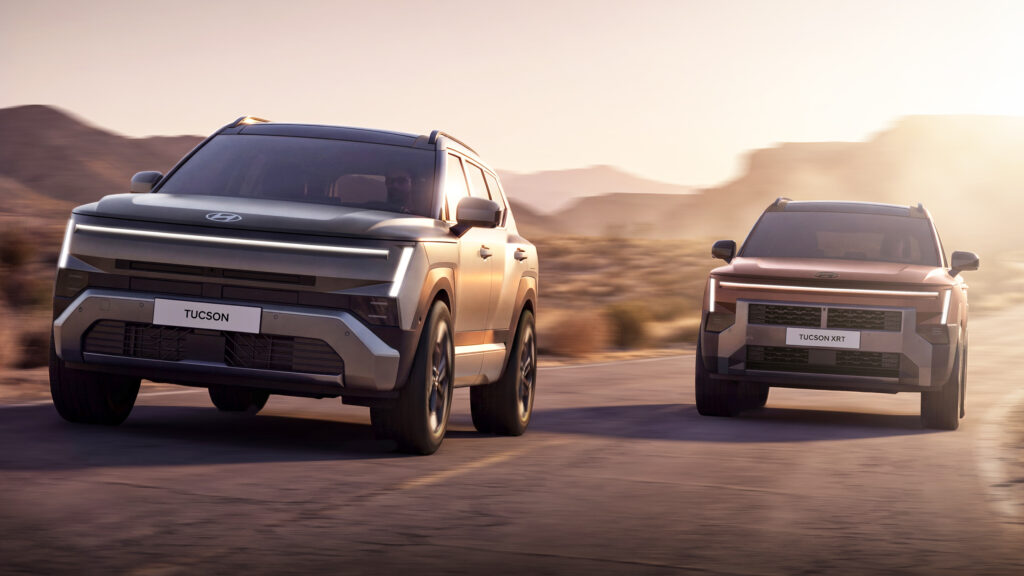
A design that looks like it escaped from a motor show
Hyundai is calling the new Tucson “The Boldest SUV.” The fifth-generation model adopts the company’s “Art of Steel” design philosophy, the same language introduced on the new Elantra (sold in the UK as the i30), and the result looks closer to a concept car than a family crossover.
The details are angular. Square wheel-arch extensions give the Tucson a planted stance, while light bars stretch across both the front and rear. Vertical taillights and upright daytime running lights complete a face that is far removed from the curvy, flowing shapes of the outgoing car. Whether it appeals will depend on taste, but nobody will mistake it for anything else in a supermarket car park.
Powertrains: petrol, hybrid and plug-in hybrid
Under the skin, Hyundai has simplified the range around a single engine family. All 2027 Tucsons use a 1.6-litre turbocharged four-cylinder in one of three configurations: conventional combustion, hybrid and plug-in hybrid. The pure petrol version produces 184 hp, and every powertrain option now benefits from an integrated electric water pump, a small but meaningful efficiency gain.
The hybrid also gains a Stay Mode, which keeps the air conditioning, heating and audio running with the engine switched off. It is a useful feature for parents waiting outside a school or drivers parked up during a long journey.
The hybrid gets a new starter motor
Hyundai has not simply carried over its hybrid system. The 1.6-litre turbo is paired with a 64 hp (47.7 kW) electric motor, but the headline addition is a new 17 hp (13 kW) crank-integrated “pancake” electric motor that replaces the traditional belt-driven starter-generator. It can assist under hard acceleration and recover energy under deceleration, blurring the line between starter and mild hybrid assistance.
Combined output ranges from 233 hp to 242 hp depending on market, with 380 Nm (280 lb-ft) of torque, up from 231 hp and 367 Nm in the previous generation. Hyundai quotes a 0-62 mph time of 8.5 seconds. Fuel economy reaches up to 42 mpg with front-wheel drive and 17-inch wheels, while all-wheel-drive models manage 40 to 42 mpg. That compares with 38 and 36 mpg for the old model.
Plug-in hybrid: 288 hp and roughly 50 miles of electric range
The plug-in hybrid is the headline act for anyone watching their benefit-in-kind tax bill. It uses the same engine and motor layout as the standard hybrid but with considerably more muscle. The main electric motor produces 106 hp (79 kW), up from 97 hp, and total system output climbs to 288 hp with 350 Nm (258 lb-ft) of torque, a 20 hp increase.
The battery grows from 13.8 kWh to 17.1 kWh, which Hyundai says delivers an estimated all-electric range of roughly 50 miles (81 km). The company has not specified which test cycle that figure uses, so treat it with the usual caution until WLTP numbers arrive for Europe. For context, the 2026 Tucson PHEV managed just 32 miles on the EPA cycle in North America.
The PHEV is sold exclusively with a six-speed automatic and four-wheel drive, hitting 62 mph in 7.9 seconds. One notable omission: there is no DC fast charging, with the on-board AC charger capped at 7.2 kW. That is fine for overnight home charging but less convenient on longer trips.
Bigger body, more space and wider-opening doors
The long-wheelbase Tucson, destined for North America, Korea and Australia, grows by 60 mm in length, 40 mm in width and 20 mm in height, with a wheelbase stretched by 30 mm to 2,785 mm. Total dimensions come in at 4,700 mm long, 1,905 mm wide and 1,684 mm tall. Europe will receive a short-wheelbase variant instead.
Practicality has improved too. Rear doors now open up to 83 degrees, 10 degrees wider than before, which makes fitting child seats considerably easier. Cargo volume stands at 1,181 litres. Ground clearance is 180 mm as standard, rising to 210 mm on the XRT Pro trim.
Inside: Android Automotive and a 17-inch screen
The cabin represents just as significant a leap. Hyundai’s new Pleos Connect infotainment system runs on Android Automotive OS, displayed through either a 12.9-inch or a 17-inch central touchscreen, paired with a slim 9.9-inch digital gauge cluster. The Gleo AI voice assistant handles complex commands without requiring the driver to touch the screen, and third-party apps including Spotify and Waze are supported. Over-the-air software updates are included.
Crucially for anyone who has grown tired of prodding glass, Hyundai has retained a row of physical buttons beneath the main touchscreen for essential functions. The dashboard is entirely new, and the tiered transmission tunnel features a raised section with a wireless charger for the driver and a recessed section with two cupholders and a charger for the passenger. Ambient lighting, plush seats and a column-mounted shifter complete the package.
Rugged trims, a sporty variant and 2027 timing
Hyundai has announced two rugged versions: the Tucson XRT and XRT Pro. The XRT Pro is North America only and gains all-terrain tyres, front recovery hooks and improved approach and departure angles, putting it in similar territory to the 2027 Jeep Cherokee Trailhawk, which pairs hybrid power with a locking rear axle and a suspension lift.
A “sport-inspired” version will premiere at the Paris Motor Show, most likely a new N Line, though Hyundai is keeping details under wraps for now.
Launch timing is staggered. South Korea receives the new Tucson later this year, with North America, Europe and other markets following in 2027. In the US, petrol and hybrid versions arrive in early 2027, with the plug-in hybrid expected to follow. Hyundai has so far only released official specifications for the petrol and hybrid variants, leaving the PHEV’s US status unconfirmed, though the outgoing model was sold there as a plug-in.
What the new Tucson means for the market
The fifth-generation Tucson arrives at a moment when the wider industry is recalibrating its electrification plans. As Nissan bets on hybrids to claw back ground in North America, Hyundai is hedging its bets rather than going all-in on battery electric. Offering a conventional petrol, a frugal hybrid and a long-range plug-in hybrid under one roof gives buyers genuine choice, and the roughly 50-mile electric range on the PHEV is a meaningful step up for company car drivers eyeing lower tax bands.
European pricing and WLTP figures have yet to be confirmed. Those numbers will ultimately decide whether “The Boldest SUV” is remembered as a brave success or a step too far.






3 Comments