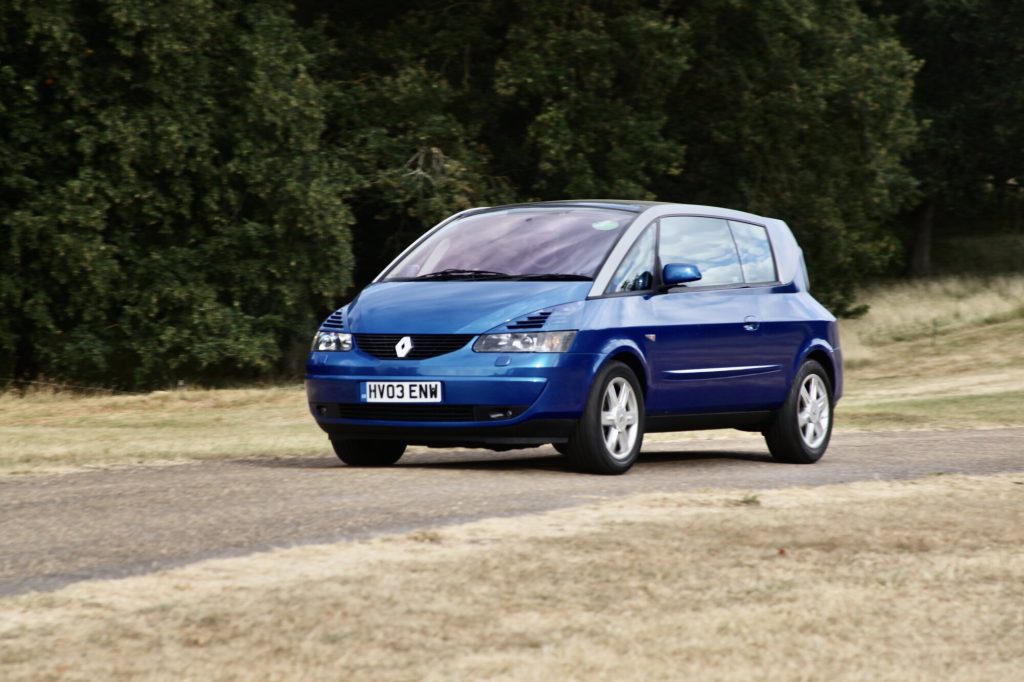
Twenty-five years ago, Renault launched a car that almost nobody bought and nearly everybody now admires. The Avantime was a pillarless, three-door MPV-coupé with concept-car proportions, doors the size of garden gates and a cabin that felt closer to a members’ club than a car park. Fewer than 9,000 were built. Its maker’s car division was wound down within two years. And yet here we are, a quarter of a century later, still talking about it.
That is the strange afterlife of a commercial disaster. The Avantime did not fail because it was badly executed. It failed because it was a brilliant answer to a question the market had not yet thought to ask. Its silver anniversary is a good moment to look at how it came to exist, what made it so radical, and why the industry still has reason to study it.
From Espace to Avantime: a partnership that needed a new car
The Avantime only exists because of the Espace, and the Espace only exists because Peugeot said no. Matra pitched its people-carrier concept to Peugeot, which judged it commercially unviable. Renault stepped in, and the Espace went on to be widely credited as the first modern European MPV. That decision laid the foundations for a 20-year partnership in which Renault supplied the dealer network and engineering resources while Matra handled manufacturing and innovation.
The arrangement worked beautifully until it did not. For the Espace’s fourth generation, Renault brought production in-house to cut costs. That left Matra with a manufacturing contract to honour and Renault with a gap to fill. The Avantime was the answer: designed and developed in-house by Matra, conceived by Philippe Guédon, head of its automotive division.
Guédon’s insight was simple and, in hindsight, rather lovely. He believed the children of Espace owners stayed loyal to the formula after leaving home, giving the estate car a new generation of drivers. The idea went to Renault design chief Patrick Le Quément, whose team turned it into something nobody had seen before: a short bonnet, a steeply raked windscreen, a high roofline and muscular rear haunches. It was a people carrier drawn by people who had been told not to draw a people carrier.
The pillarless wonder
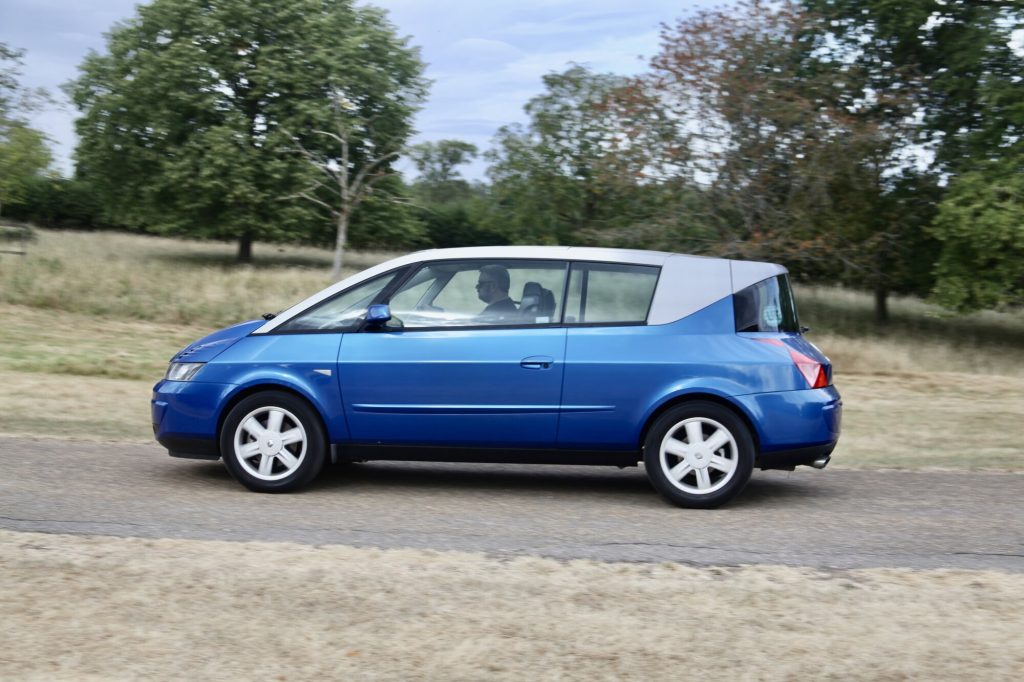
The Avantime’s party trick was structural and theatrical at once. There was no central B-pillar, which meant an uninterrupted expanse of glass down each side and a cabin that could be opened entirely to the outside. Lower all four side windows, swing open both doors, and the car turned into a glass-walled lounge.
Those doors were among the largest ever fitted to a mainstream production car, and they needed clever engineering to be usable. A double-hinged mechanism let them swing outward and then forward, cutting the lateral space required to get in and out. In a tight car park, that mattered. It remains one of the more intelligent packaging solutions of its era, and it is the sort of genuinely useful innovation that tends to get lost when a car is remembered mainly for its shape.
Then there was Grand Air, Renault’s name for the full open-air mode: all side windows lowered and the large electric sunroof retracted. It delivered something approaching convertible motoring without sacrificing structural rigidity. Le Quément was characteristically proud of the details, citing at launch “little touches of madness, such as the treatment of the rear lights in the shape of a kite, inherited from the Fiftie concept car”. He added: “There are many things on this vehicle that I think are very successful, and I like its interior as much as its exterior. For me, it is a complete project.”
A lounge on wheels
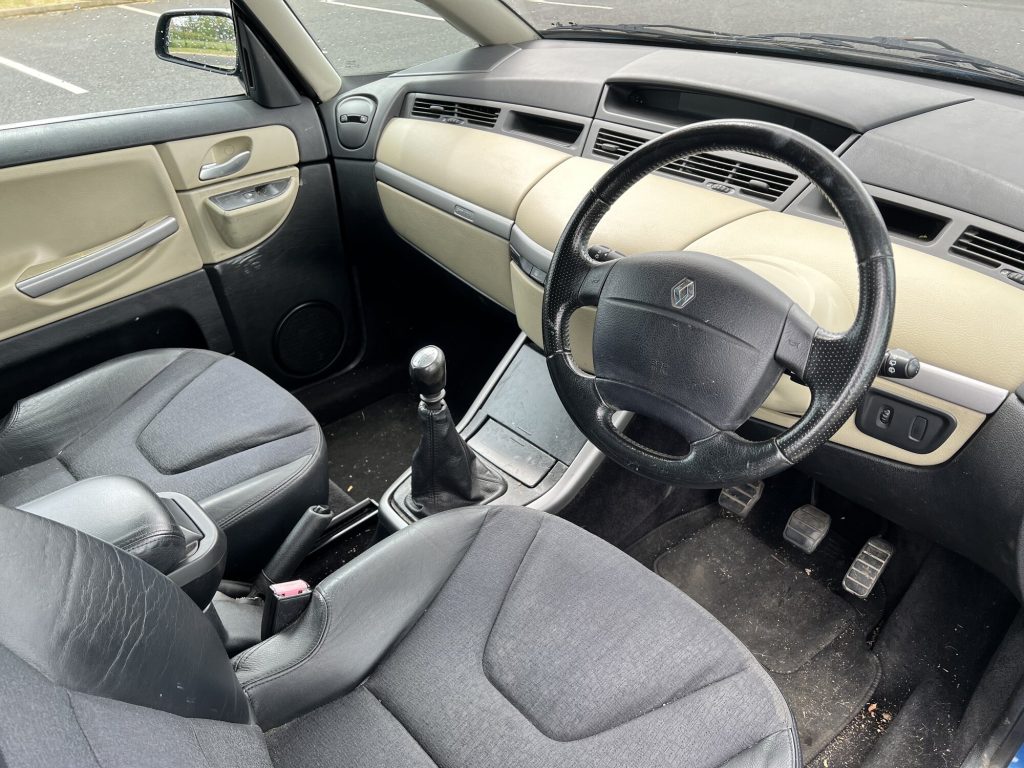
Inside, the Avantime leaned hard into the lounge brief. Natural light flooded the cabin, the seating positions were set high for visibility, and the rear seats were mounted higher than the front in a theatre-style layout so passengers in the back could see forward over those ahead. It was a small piece of social engineering: everyone gets a view.
The dashboard was clean and restrained, with sweeping forms replacing the angular clutter that dominated interiors of the period. Where rivals stacked buttons and hard edges, the Avantime went for calm. It was a cabin designed around the experience of being in it rather than the specification list, an approach that has aged considerably better than most of its contemporaries.
That willingness to rethink the cabin is worth remembering at a moment when the industry is arguing about how much technology belongs in front of a driver. The Avantime’s answer was the opposite of a screen: more glass, more light, fewer distractions. It is a philosophy that looks quietly prescient as regulators elsewhere start to scrutinise screen-heavy dashboards, with China’s proposed rules on distracting in-car tech being watched well beyond its borders.
Launch, and a short commercial life
The Avantime made its debut at the 1999 Geneva motor show as a concept, reached showrooms in 2001 and was gone by 2003. The name is a portmanteau of “Avant” (before) and “Time”, which reads now like an unintentional prophecy. It was offered with a choice of two petrol engines, a 2.0-litre four-cylinder and a 3.0-litre V6, the latter paired with a six-speed manual, and priced firmly in premium territory for a Renault of its day.
It was discontinued within two years, with fewer than 9,000 cars built and sold, a figure commonly put at around 8,500. Matra Automobile ceased production and its Romorantin plant closed, ending the company’s era as a car maker. That is a tiny number by any measure, and it explains why the Avantime has become a fixture at shows and in classifieds rather than on driveways.
Why it failed, and why it matters
The Avantime was a niche within a niche. It asked buyers to pay premium money for a car that was neither a proper MPV nor a proper coupé, with looks that split opinion cleanly down the middle. Those who loved it really loved it. Everyone else walked into a showroom and bought something sensible. In a market that rewards clear categories, the Avantime refused to pick one.
Its influence, though, is harder to dismiss. Renault spent the following decade cheerfully ignoring convention with cars that did not fit neat boxes, and the Avantime is the point where that instinct became a design philosophy rather than an accident. Concept-car thinking reached production, even if the sales figures never followed. Plenty of manufacturers have since discovered that a distinctive shape can carry a model further than a specification sheet, and the Avantime got there first.
The Avantime as a lesson in brave design
Twenty-five years on, the Avantime looks less like a failure and more like a preview. The pillarless glasshouse, the theatre seating, the refusal to accept that a tall car had to look dull: all of it has filtered into how designers think, even when the badge on the bonnet is different. The car that nobody bought has become the one everybody references.
Cult status is a consolation prize, but it is not a trivial one. Cars that ignore convention tend to be remembered. Cars that follow it tend to be forgotten, however many of them were sold. On that measure, the Avantime won.
Related: renault 138 baguette holder.