China’s Ministry of Industry and Information Technology (MIIT) has opened a public consultation on sweeping new rules covering car design and technology, and the proposals take direct aim at some of the most heavily marketed features in the modern cabin. The move follows China’s earlier restrictions on pop-out (flush-fitting) door handles and “yoke” steering wheels, introduced on safety grounds, and it signals that Beijing is prepared to regulate cabin design in a way no other major market has attempted.
The rules as drafted cover models sold in China. In practice that shapes cars far beyond Chinese borders, because manufacturers seldom tool a separate cabin for the same global model. European and UK buyers could find that features currently used as showroom selling points quietly disappear from the cars they are offered.
Infotainment systems face safety evaluations
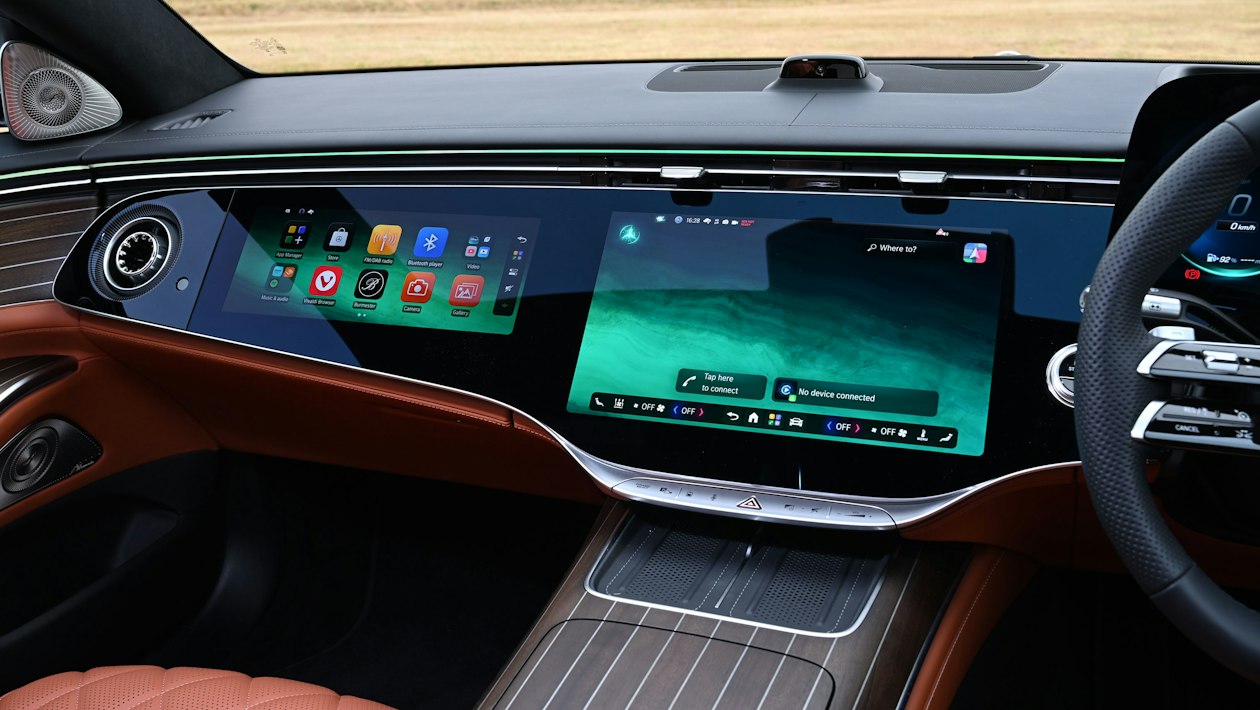
The proposals single out cars fitted with central touchscreens, large displays and head-up displays (HUDs). Under the MIIT’s plans, these systems “must undergo safety evaluations regarding information presentation impact on driving safety, functional reliability in extreme environments, and collision safety assessments.”
That wording matters. It means an infotainment system could be banned outright if regulators judge it too distracting or insufficiently robust. The consultation effectively puts the burden on manufacturers to prove that a screen does not compromise the driver’s attention, that it keeps working in extreme heat and cold, and that it meets collision safety requirements.
For an industry that has spent years migrating functions from physical switchgear to touchscreens, this is a significant reversal. The largest, most complex displays are precisely the ones that tend to attract the most scrutiny under this kind of framework.
Folding and flexible displays face an outright ban
The MIIT plans a blanket ban on “folding” and “flexible” displays. The timing is notable: the proposal lands shortly after Chinese tech firm BOE showcased infotainment screens that fold away like a laptop or bend to give occupants a better viewing angle.
Those concepts generated plenty of headlines, but under the proposed rules they would not reach production in China. A blanket ban leaves no room for a safety evaluation or a partial approval. Flexible screen technology, at least in this application, would be closed off in the world’s largest car market.
Physical controls for critical functions
Critical functions including gear shifters, window defrosters and headlight controls would have to be operable via physical buttons and switches. This is the clearest signal yet that the pendulum is swinging back towards tactile controls for the functions drivers need without looking away from the road.
The approach echoes Euro NCAP’s direction of travel in Europe, where physical controls are being folded into the scoring for top safety ratings. As we reported, Euro NCAP Won’t Force Physical Climate Controls – But It’s Still Marking Cars Down for Touchscreens, with a spokesperson confirming there are “no plans to require manufacturers to fit physical buttons for climate control and media,” as we reported. The distinction is important: Euro NCAP is not mandating hardware, while China’s proposals would write specific requirements into law.
Zero gravity seats and customisable headlights
China also plans to ban “zero gravity” reclining seats, the type that fully recline in the manner of a first class airline seat, from being used while the vehicle is in motion. These seats have become a fixture of Chinese domestic EVs in particular, marketed as a comfort feature for passengers waiting while charging or resting between journeys. The proposal does not remove them from cars, but it prevents their use on the move, where a reclined occupant is far less protected in a collision.
The consultation also addresses headlights. User-customisable headlights would be moderated to ensure they do not “impact on the safety of other road traffic participants.” Predetermined light signatures, such as those offered by Audi and MINI, would remain allowed. The line being drawn is between fixed, type-approved lighting designs and systems that let drivers project their own patterns or messages onto the road.
That concern is not unique to China. In the United States, the National Highway Traffic Safety Administration has announced plans to modernise Federal Motor Vehicle Safety Standard No. 108, as we covered in NHTSA Moves to Modernise US Headlight Rules as Glare Complaints Mount, with the date as reported in that earlier coverage. The direction of travel across markets is towards tighter control of what headlights are permitted to do.
Why exported models are affected
The reach of the rules is the detail that matters outside China. As drafted, they would phase the affected technology out of models sold in China, and manufacturers rarely build two entirely different cabins for the same model. A global platform typically carries one interior architecture, and if the Chinese-market version must drop a folding display or reinstate a physical gear selector, that decision tends to cascade across other markets. The economics of tooling a separate dashboard for Europe seldom stack up.
Europe is already asking questions
The EU is said to be investigating the safety impact of pop-out door handles, partly prompted by China’s bans. That is a notable development: it suggests Chinese regulation is now influencing the European agenda, rather than the other way round.
The safety case against flush handles rests on concerns about emergency access and egress. If a vehicle loses power in a crash, or if a passer-by needs to reach an occupant quickly, a handle that does not present itself physically can complicate rescue. Several manufacturers have already begun revisiting the design.
What the consultation means for the next generation of cars
The MIIT’s proposals are still out for consultation, so the final text may shift. But the direction is unmistakable. China is prepared to legislate against cabin features that regulators judge distracting, unreliable or unsafe, and it is willing to do so before the rest of the world acts.
For manufacturers, the calculation is straightforward. Designing to the strictest major market is cheaper than designing to several. If China bans folding displays and mandates physical controls for gear selection, defrosting and lighting, those choices are likely to become the global default.
The likely outcome is a cabin that looks less like a concept car and more like a car. Screens will remain, but they will be smaller, simpler and more closely scrutinised. Physical switchgear will return for the functions that matter most. Reclining seats will still be fitted, but they will not be usable while the car is moving. Customisable headlight projections may disappear entirely.
None of this is guaranteed, and the consultation process could soften some provisions. What is clear is that the era of adding technology to the cabin simply because it can be added is coming under sustained pressure from regulators who are no longer convinced that more screens mean better cars. The next generation of vehicles will be shaped as much by safety officials as by designers, and that shift is already under way.