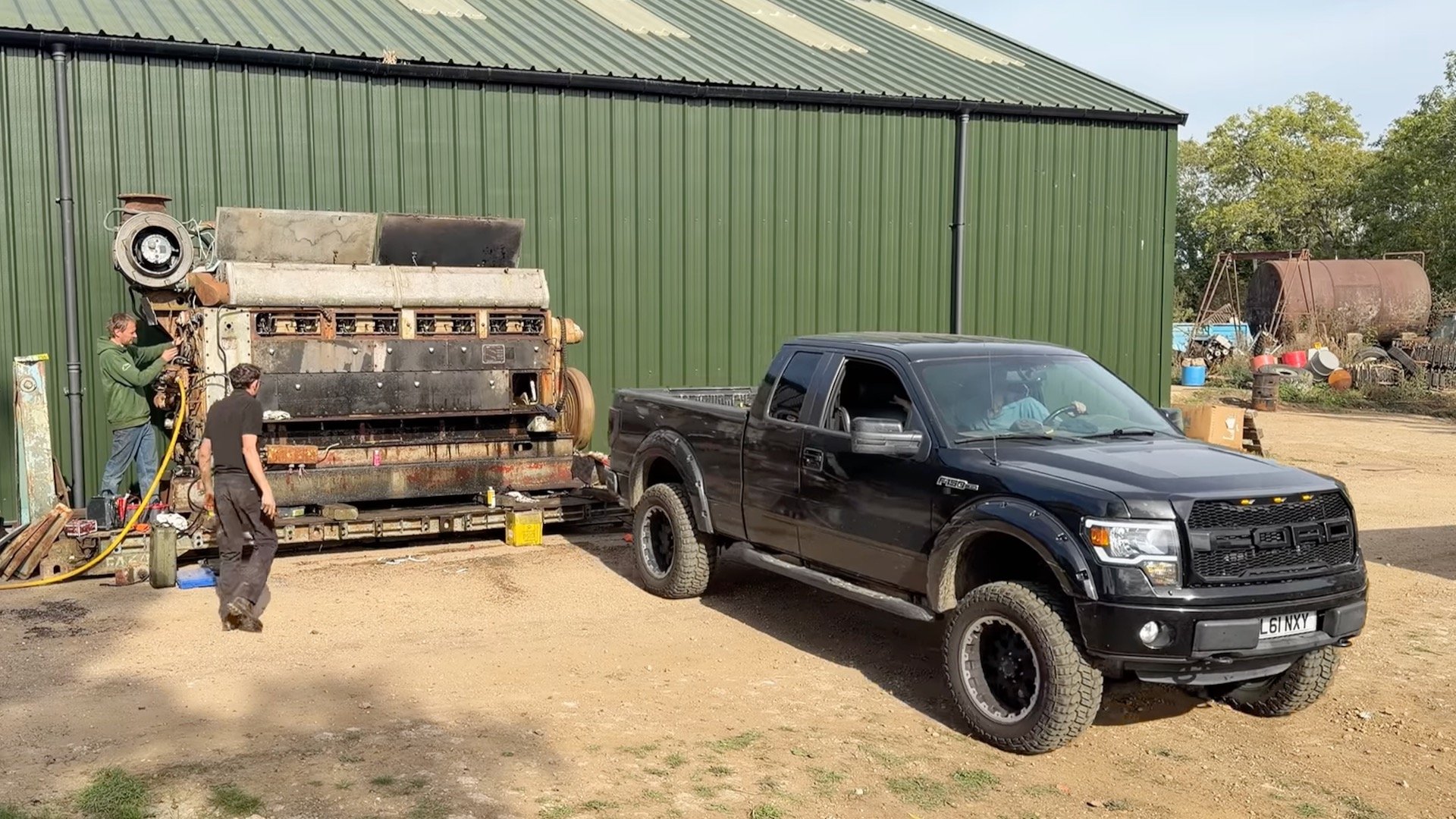
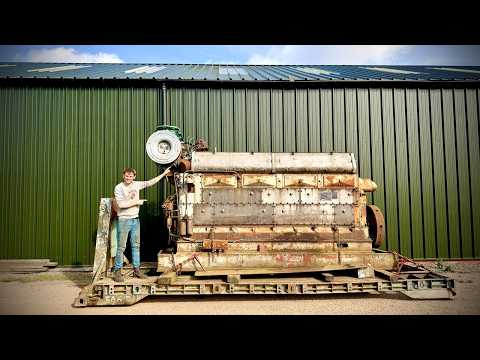
For more than seven decades, a slab of British industrial engineering has been sitting quietly in a corner of the world, its 102.4-litre capacity dormant, its eight cylinders silent. The Mirrlees Blackstone JS8 was never meant to be a showpiece. It was built to sit in the shadows of a Royal Air Force base and wait for the moment the lights went out. Then, one day, YouTuber Mr Hewes decided to wake it up.
The result is one of the more improbable restoration videos on the internet: a giant stationary diesel brought back from the dead not with a specialist tool kit or a factory service manual, but with a ratchet strap and a pickup truck.
What Exactly Is a Mirrlees Blackstone JS8?
The JS8 is a 102.4-litre straight-eight turbodiesel, delivered new to the UK Air Ministry in 1953. Mr Hewes, whose channel specialises in vintage agricultural and military machinery, believes it spent its working life as part of a generator set, or genset, on an RAF base. The engine itself is British, though the restoration is being carried out on the other side of the Atlantic, which is why the recovery vehicle in the video is a US-market pickup rather than anything you would find in a British yard.
A genset is exactly what it sounds like: a self-contained package that bolts a stationary engine to a generator and the associated hardware, usually installed as emergency backup power for large buildings or mounted on an outdoor concrete pad. When the grid failed, the JS8 was expected to carry the load. In an era before reliable solid-state electronics, that meant a mechanical beast with enough reciprocating mass to shrug off a sudden demand for power.
The genset concept also had a brief and not especially glorious flirtation with rail traction, where similar stationary engines were pressed into locomotive service. It was not a success, and the JS8’s natural habitat remained the fixed installation: heavy, immovable and utterly dependable.
720 Hours and a Thick Coat of Patina
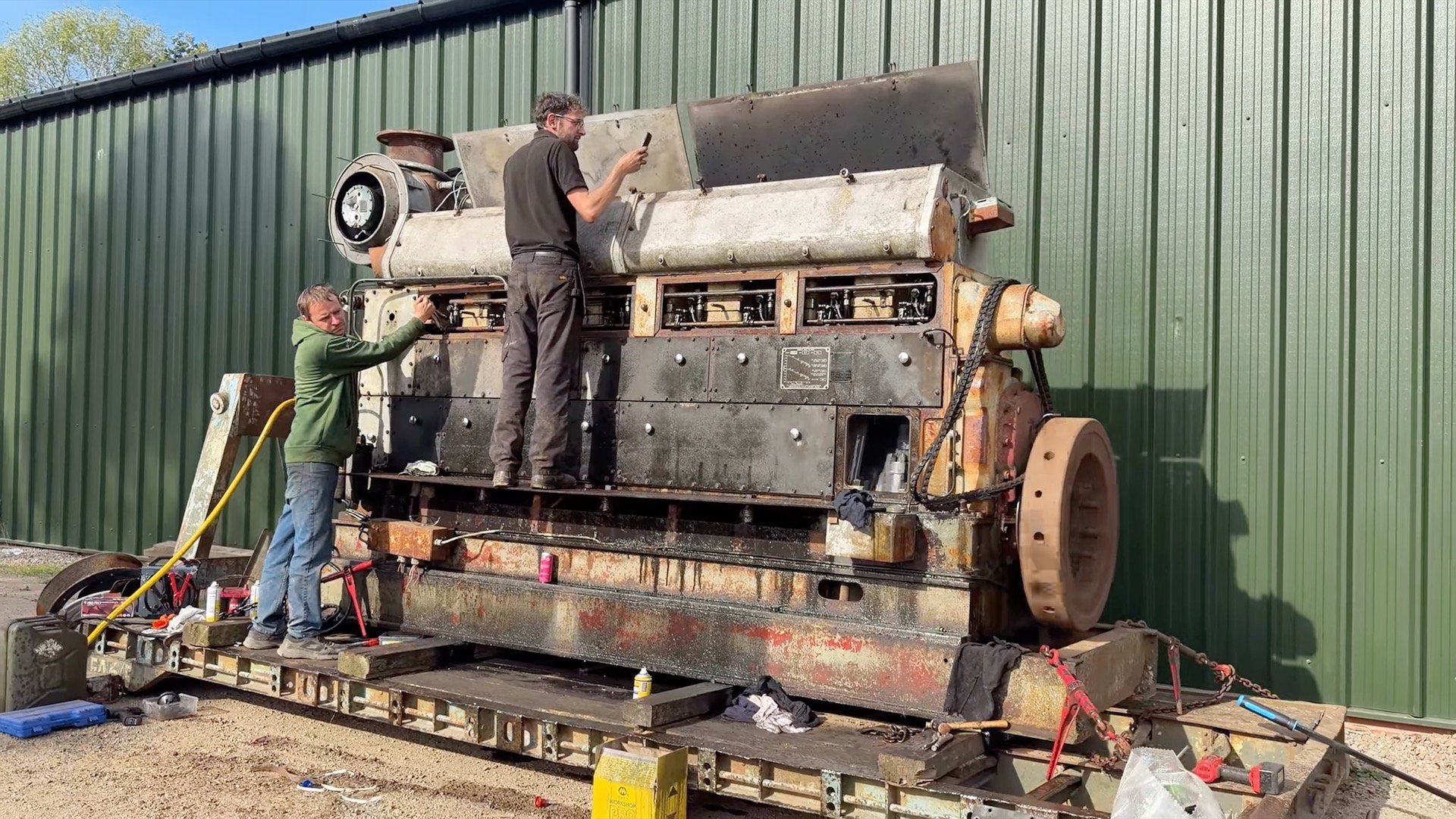
On paper, the engine looked almost new. Its hour meter showed just 720 hours of accumulated running time, a figure that would be unremarkable on a modern diesel but is extraordinary for a machine built in 1953. Seventy-odd years old, and it had barely done a fortnight’s work.
The reality was less encouraging. A thick layer of patina across the castings told the real story: this engine had not run for a very long time. Engines that sit idle do not simply wait patiently. They corrode, seize and fill with condensation, and the JS8 had suffered on every count.
Stuck valves and injectors were the first problem. A non-functioning oiling system was the second. Worst of all, the oil passageways had filled with water, which had to be pumped and vacuumed out by hand before there was any prospect of the engine turning over, let alone running. This is the unglamorous reality of reviving heavy machinery: hours of draining, flushing and coaxing before anyone gets to hear a single combustion event.
Compressed Air, Forklifts and a Very Stubborn Flywheel
Large stationary diesels of this vintage are not started with a key. They are designed to be turned over with compressed air, a system that uses stored pressure to push the pistons and spin the crankshaft up to firing speed. It is simple, robust and works beautifully, provided you have enough air.
Mr Hewes did not. The available compressed air supply was insufficient to budge the JS8, which is roughly what you would expect when trying to spin a straight-eight of this size from cold.
Plan B involved a handle on the flywheel and a forklift, the idea being that a few tonnes of counterbalance truck could do what compressed air could not. That failed too. The engine simply refused to rotate.
Plan C is the one that made the video. Mr Hewes tied a ratchet strap around the flywheel and yanked it with a pickup. It is a method that would make a workshop foreman wince, and yet it worked: the strap bit, the flywheel turned, and the engine began to spin with enough momentum to fire.
It is worth pausing on the contrast here. A 1953 RAF genset got its pulse back courtesy of a pickup truck and a length of webbing, a very different approach from the polished, high-budget builds that usually dominate restoration coverage.
Smoke, Noise and a 70-Year-Old Heartbeat
When the JS8 finally caught, it did so in the manner of all big, cold, long-dormant diesels: reluctantly at first, then with a bellow of smoke and a wall of noise that leaves no doubt about what 102.4 litres of turbocharged capacity sounds like at idle.
For Mr Hewes, it is the latest in a run of projects that treat heavy machinery as something worth saving rather than scrapping. He previously collaborated with fellow YouTuber Scott Nothing To Do With You on modernising a Rolls-Royce Meteor engine from a Centurion tank. That V12 displaced 27.0 litres, which sounds enormous until you remember it is roughly a quarter of the JS8’s capacity. The Meteor is a tank engine with a famous bloodline; the JS8 is a generator engine with no bloodline at all, which is arguably what makes its revival more interesting.
The full restoration video runs nearly an hour, and it earns its runtime. There is no dramatic reveal, no polished paintwork and no dyno figure. There is diagnosis, frustration, water where oil should be, and a series of failed starting attempts before the one that works.
That is precisely the appeal. In an era when even family hatchbacks are software-defined and dealer-locked, there is something bracing about an engine you can understand by looking at it. The JS8 has no ECU, no sensors and no diagnostic port. It has fuel, air, compression and a flywheel heavy enough to require a pickup truck to move it. When it runs, you know why.
Britain built many stationary engines like the JS8 for industry, agriculture and defence, and many were scrapped when the sites they powered were decommissioned. The survivors tend to sit in the hands of enthusiasts, museums or farmers who cannot quite bring themselves to weigh them in. Every one that runs again is a small act of preservation, achieved with whatever is in the yard.
The Mirrlees Blackstone JS8 is not fast, not beautiful and not remotely practical. It is 102.4 litres of British engineering that spent 70 years waiting for an emergency that never came, and it has now been coaxed back to life by someone with a strap, a pickup and a great deal of patience.