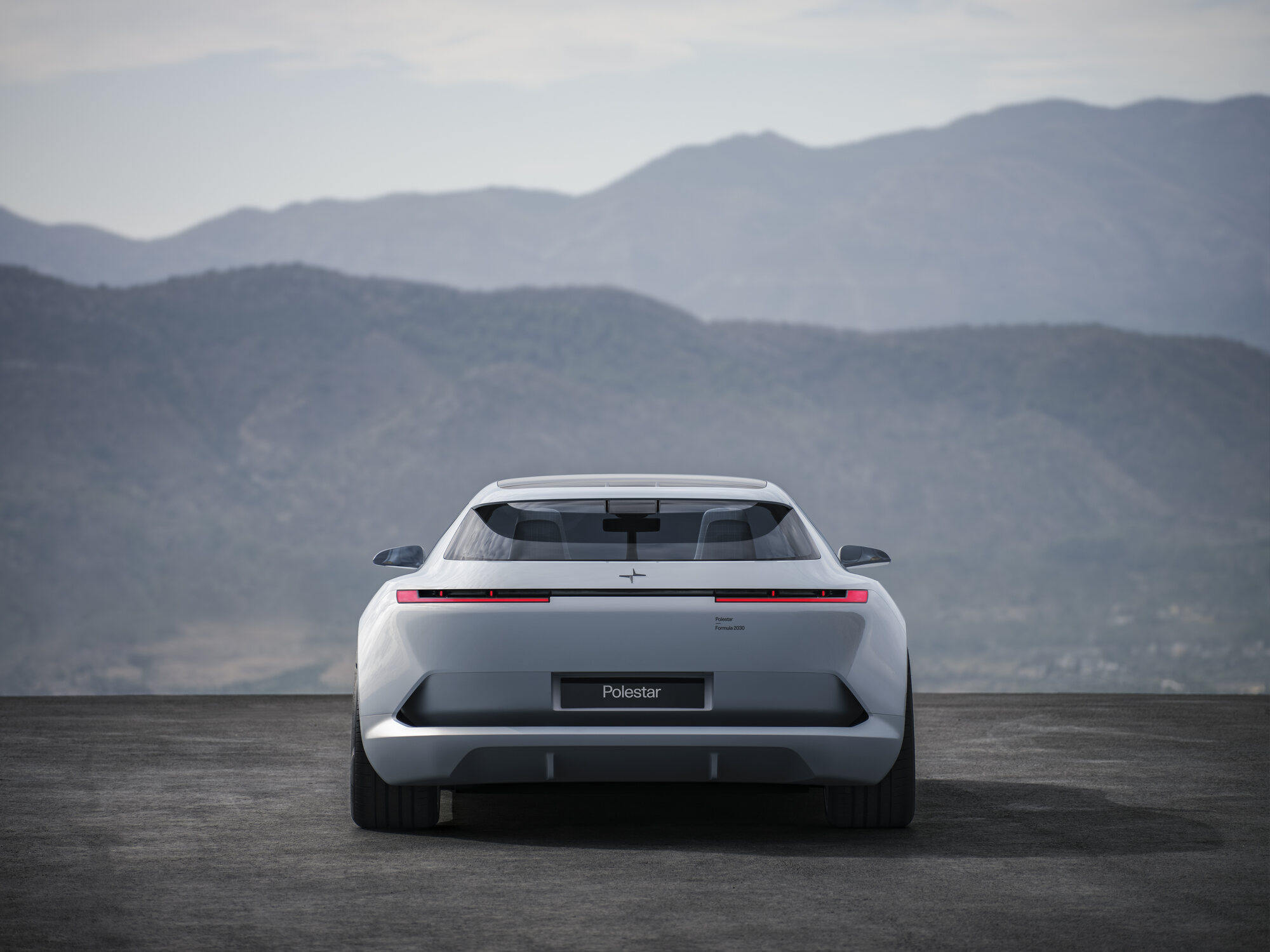
Polestar has a habit of making concepts that look like they have escaped from a design studio’s wish list rather than a production plan. The Formula 2030 is no exception. Revealed in full, it is a low-slung, four-door electric sports car that the Swedish brand is happy to call a “compact practical four-door sports car” sitting “within its own segment,” which is Polestar-speak for a shape nobody else is currently building.
The significance goes well beyond the show stand. The Formula 2030 is the design blueprint for the next-generation Polestar 2, which Polestar says is due in 2027, and the Polestar 7 compact SUV, due in 2028. It is also the first show car created under head of design Philipp Römers, who joined from Audi in 2024, and it marks a quiet but important about-face on interior controls from a brand that built its recent reputation on putting almost everything into a touchscreen.
A concept with a production deadline
Polestar first confirmed the Formula 2030 in September, after showing it privately to investors and retailers in Gothenburg. Its public debut came during the media drive of the Polestar 4 SUV, which tells you something about how the company views the car: not as a distant flight of fancy, but as a statement of intent parked next to the metal customers can order today.
The brief, according to Polestar, was a compact, practical four-door sports car. That combination is rarer than it sounds. Plenty of brands have built low electric saloons, but few have managed to package four usable seats and a boot into something this close to the ground.
The numbers behind the stance
At 1,350 mm tall, the Formula 2030 sits lower than the Polestar 5 grand tourer, which is itself no high-rider. Length is 4,680 mm, width 2,021 mm and the wheelbase stretches to 2,780 mm.
Put those figures against the car it previews and the ambition becomes clear. The concept is roughly 75 mm longer and about 125 mm lower than today’s Polestar 2. It is slightly shorter than a Tesla Model 3, and around 90 mm closer to the ground. Polestar says it lands “somewhere between” the upcoming Polestar 2 and the Polestar 7 in size, which is a useful hint that the next 2 will grow only modestly rather than balloon into a full-size saloon.
Exterior: a new face for the Polestar 2
The proportions do most of the talking. A long bonnet, short overhangs and a cabin pushed back over large rear haunches give the Formula 2030 a stance that reads as rear-driven even before any powertrain details exist. It rides on 22-inch centre-lock wheels with gold Brembo calipers, and Öhlins dampers are displayed in the boot, a nod to Polestar’s long-running chassis partnership.
The front end is the part that matters most for buyers. Dual Blade headlights are set into an aero wing above a shark nose and a deep splitter, and Polestar describes this as the face of the next-generation Polestar 2 planned for 2027. If that holds, the production car will look considerably more aggressive than the current model.
Elsewhere there is a single vertical race-car-style windscreen wiper, a LiDAR unit hidden under an aerodynamic shroud that only appears when the car is driving autonomously, and Single Blade rear lights replacing the full-width light bar. Polestar says the new rear signature is being introduced ahead of series production, so expect to see it on showroom cars soon.
The doors are rear-hinged at the back with no B-pillar, opening the whole side of the car to reveal four individual seats. That is the kind of detail that rarely survives the transition to production, but the thinking behind it, a cabin designed around four distinct occupants rather than a bench, may well carry over.
Inside: Polestar rethinks the touchscreen
This is where the Formula 2030 gets genuinely interesting. Polestar has spent years routing most functions through a central touchscreen, to the frustration of plenty of reviewers and owners. The concept reverses part of that.
A curved 20-inch display, which Polestar calls HyperDIM, is mounted on the steering column rather than the dashboard. A 12.2-inch centre screen sits in the centre tunnel, and below it is a panel of eight physical controls. Owners can swap the control types, choosing between rocker switches or rotary knobs for example, and program each function to suit them.
“As a performance brand, we see a renewed focus on the driver, and so we re-balance the digital and physical,” says Juan Pablo Bernal, head of interior design. “We introduce physical buttons and controls.”
The cabin also physically reconfigures across three drive modes: Performance, Normal and Autonomous. In Performance, the centre screen drops flush into the console and the wheel and its display pull closer to the driver. In Autonomous, the wheel and seat move apart to free up space. It is the sort of mechanical theatre that usually stays in concept land, but the underlying philosophy, fewer menus, more tactile controls, is one Polestar says it is committing to.
The seats use inflatable bolsters that shape to each occupant, and the seat backs are made from a flax-based composite instead of virgin plastic, a sustainability detail that fits the brand’s stated priorities. Google Gemini is built in, mirroring what Polestar already offers in production cars. That same assistant is now spreading across the industry, and it recently arrived in the Mazda CX-5 via an over-the-air update, which gives a decent indication of how quickly conversational voice control is becoming the norm rather than a novelty.
Practicality has not been ignored either. The clamshell rear opens to a transparent boot floor, with custom Polestar bags strapped underneath on gold straps. Up front, the storage area holds two race helmets and a fire extinguisher, framed by a gold strut brace. It is show-car theatre, but it also makes the point that this is a car designed to be used, not just admired.
What Polestar is not saying
There are no powertrain specifications at all. No battery size, no range, no power output and no price. The Formula 2030 is a design study, and Polestar is not committing to building it.
What the company will say is that various design attributes will appear on the next Polestar 2 in 2027 and the Polestar 7 in 2028. Those are two of four new models planned over three years, and the 7 will be built in Europe.
Römers describes the concept as a “bold evolution” of the brand’s design and “a physical embodiment of how we apply Polestar’s core values of design, performance and sustainability to the next production cars.” Read that closely and the message is clear: the show car is the argument, the production cars are the conclusion.
Europe is the market that counts
One piece of commercial context is worth keeping in mind. Polestar is effectively shut out of the US market under the federal connected-vehicle rule, which makes Europe the key market for these next models. That raises the stakes on the next Polestar 2 in particular, a car that has to compete in one of the most crowded segments in the business against established rivals and a wave of newer Chinese entrants.
Polestar’s approach with the Formula 2030 looks measured. It is striking without being alien, and the decision to bring back physical controls suggests the brand has been listening to criticism rather than doubling down on it.
The verdict: a concept that actually tells us something
Most concepts are exercises in wishful thinking. The Formula 2030 is different because Polestar has attached dates, names and a production plan to it. The return of proper buttons and knobs, programmable to the driver’s taste, is the detail most likely to matter day to day.
What we do not have is any idea of what will power it, how far it will go or what it will cost, and those are the questions that will decide whether the next Polestar 2 succeeds. As a statement of design direction, though, the Formula 2030 does its job. The real test comes in 2027, when the show car has to become a car people can actually buy.