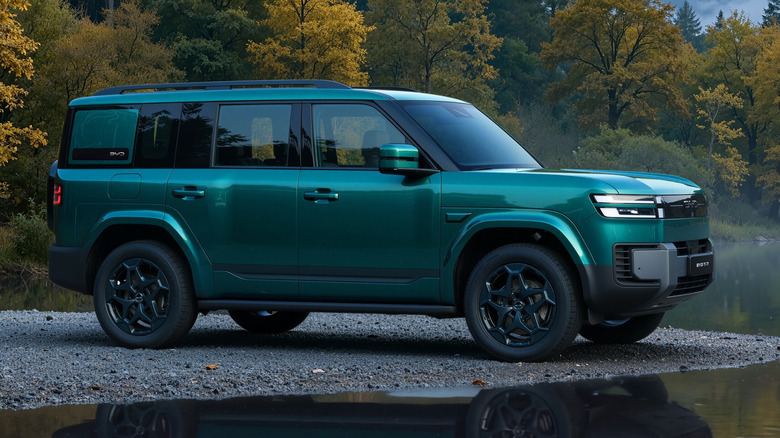
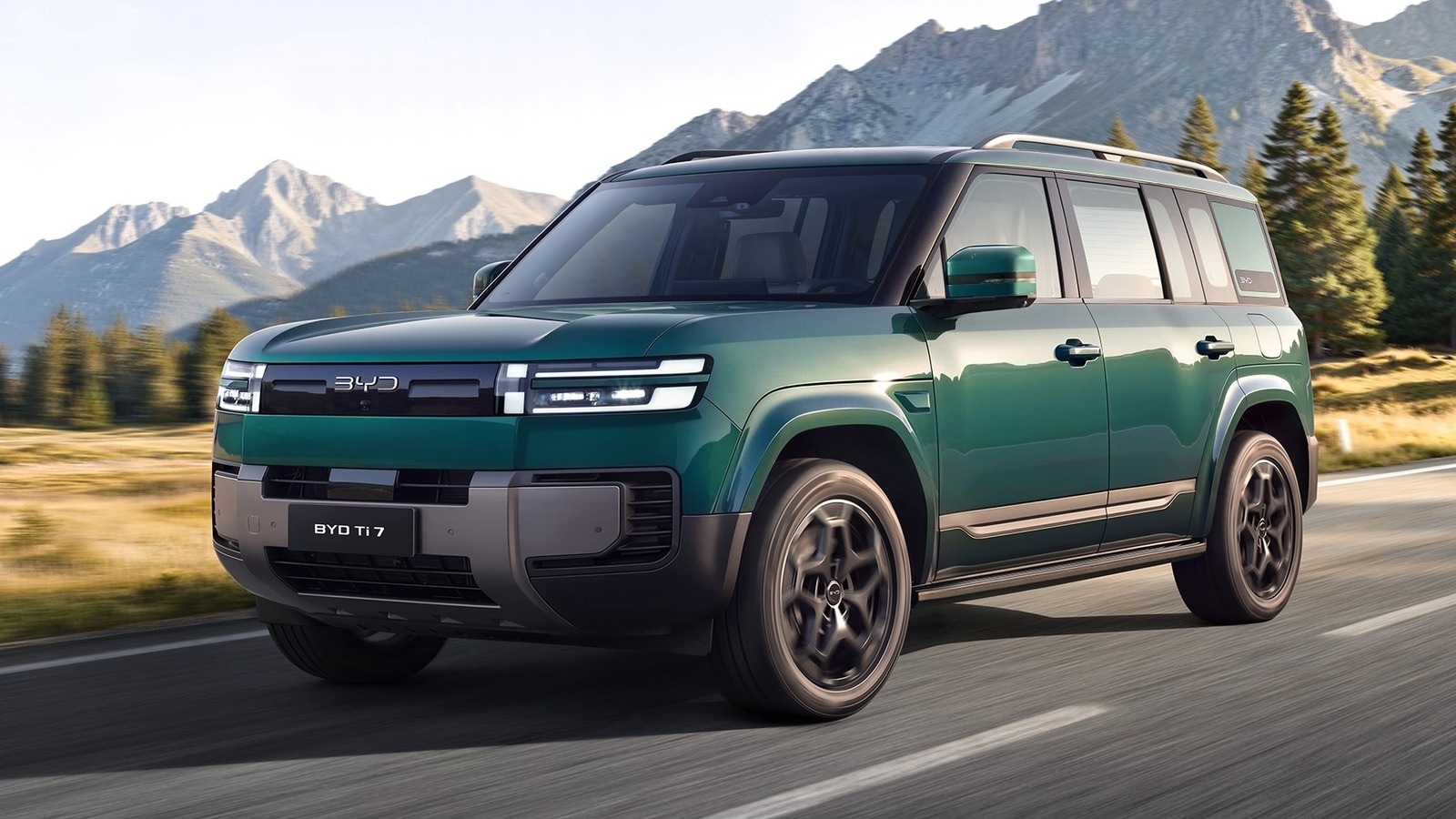
The row between Jaguar Land Rover and BYD has moved from legal paperwork to something considerably more dramatic. Court-ordered bailiffs have searched BYD’s offices in the Netherlands, seizing documents and digital records as part of JLR’s claim that the BYD Ti7 copies the Land Rover Defender. The news broke only days before a preliminary ruling at The Hague was due to decide whether the Ti7 infringes the Defender’s intellectual property.
It is an extraordinary escalation. Car companies argue about styling all the time, usually through lawyers’ letters that never see daylight. Sending bailiffs in is a different register entirely, and it signals just how seriously JLR views a £47,995 seven-seat hybrid that undercuts its own Defender by more than £20,000.
Bailiffs search BYD’s Dutch offices
The raid took place in August, according to The Times, but only became public in the days before the hearing. Court-appointed bailiffs acting for JLR searched BYD’s premises in the Netherlands and seized both paper documents and digital records. JLR’s legal team reportedly hoped to find evidence that BYD reverse-engineered the Defender before any files could be deleted. As we reported at the time, the operation was aimed at securing material before it could disappear.
BYD’s lawyers were unimpressed. They described the operation as a “fishing expedition” and complained that “too many files were seized.” The company insists it had cooperated fully with JLR’s earlier requests for information, and both JLR and BYD declined to comment on the ongoing case. That is standard practice in live litigation, but it leaves the public record resting on court filings and briefings rather than anything either side is prepared to say on the record.
The car at the centre of the fight
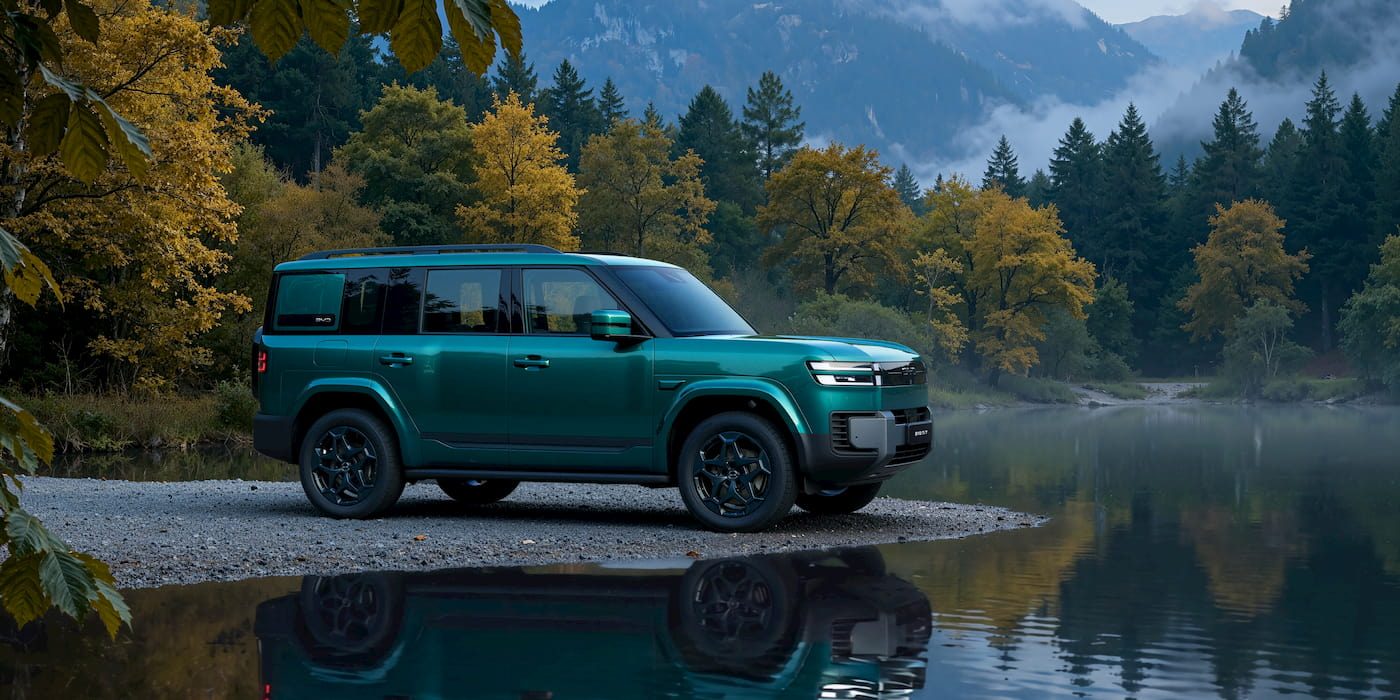
The Ti7 was revealed in China last year and arrived in Europe and the UK with orders opening in late July. It is sold in Britain exclusively in flagship Excellence AWD trim at £47,995 on the road, which makes the positioning unusually simple: one powertrain, one specification, one price.
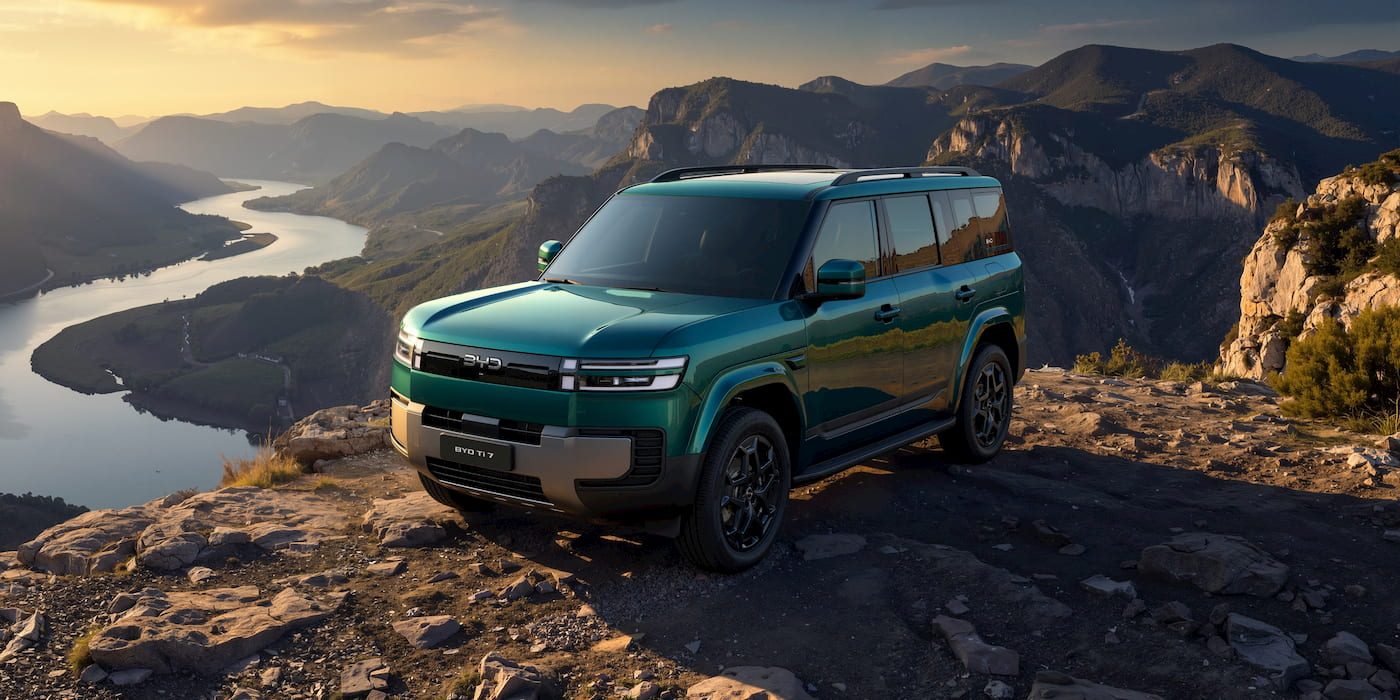
BYD’s own description of the car does it no favours in a design dispute. The company markets it as having “an unapologetically boxy profile” with “the imposing, chunky design that finds favour among SUV buyers, yet delivers a contemporary look.” Boxy and chunky is, of course, the Defender’s entire visual signature. Whether that amounts to copying or simply competing in the same segment is precisely what the court has been asked to decide.
What the Ti7 offers for the money
The hardware is serious. The Ti7 uses BYD’s DM-p Super Hybrid system, pairing a 1.5-litre turbocharged four-cylinder engine with electric motors for a combined 402 hp. BYD quotes 0 to 62 mph in 4.8 seconds, which is brisk for a seven-seat family SUV and comfortably ahead of the entry Defender.
A 35.6 kWh Blade Battery provides up to 74 miles of WLTP electric range, rising to as much as 102 miles in city driving. That is a genuine plug-in hybrid proposition rather than a token electrified badge, and it is the first BYD model for the UK built on the DM-p powertrain. The seven-seat layout was specifically designed for European and UK buyers, and BYD claims the Ti7 “vastly exceeds the closest competition” with “a level of equipment that exceeds anything that its rivals can offer at this price point.”
The price gap that explains the tension
Land Rover’s problem is easy to state in numbers. A base Defender 110 costs over £16,000 more than the Ti7. Move to the plug-in Defender 110 and the gap widens to more than £20,000, with the PHEV starting at £71,840 against the BYD’s £47,995.
For buyers weighing up a boxy, hybrid-capable family SUV, that is not a rounding error. It is the difference between one car and one car plus several years of running costs. JLR’s concern will be less about a single model than about what happens if Chinese manufacturers can deliver Defender-adjacent styling and plug-in hardware at two-thirds of the price, at scale, across Europe.
Why The Hague matters beyond these two companies
The preliminary ruling was scheduled to determine whether the Ti7 infringes the Defender’s intellectual property. Whatever the outcome, the reasoning will be studied closely across the industry. A finding in JLR’s favour would give European manufacturers a template for challenging Chinese design language in European courts. A finding for BYD would suggest that “boxy” is a genre rather than a protected asset, opening the door for more manufacturers to pitch rugged silhouettes at mainstream prices.
The timing is awkward for BYD. The company is expanding rapidly across Europe, and the case lands alongside a broader political mood that is turning against Chinese imports, with UK Weighs Tariffs on Chinese Cars in Bid to Join EU’s ‘Made in Europe’ Scheme reporting that the UK government has been weighing its own response, with reports of plans drawn up by Business Secretary Jonathan Reynolds for levies on Chinese vehicles. A design ruling against BYD would add legal friction to commercial friction at exactly the wrong moment.
JLR has done this before, and won
This is not JLR’s first attempt to protect a silhouette. In 2016 the company took China’s Jiangling Motor Corporation to court over the Landwind X7, an SUV that in its home market cost the equivalent of a fraction of the first-generation Evoque it so closely resembled. The Chinese court found that JMC had copied five distinct Evoque design details, ruled in JLR’s favour and ordered an immediate halt to X7 production.
That precedent is why the bailiffs were sent rather than another letter. JLR knows the playbook works, and it knows that securing internal evidence early is often what separates a successful design claim from an expensive failure.
The copycat pattern is wider than one car
The Ti7 is not the only Chinese SUV to attract unfriendly comparisons. The Jaecoo 7, built by Chery, has been nicknamed the “Temu Range Rover” for its low price and its resemblance to the Range Rover Freelander and Evoque. It also became the first Chinese vehicle to top the UK car sales chart, and JLR has not taken legal action over it. That restraint is telling: sales success alone does not trigger a claim, and JLR appears to pick its battles carefully.
Elsewhere, the copying has been more brazen. Earlier this year, Great Wall Motor chairman Wei Jiangjun publicly apologised after his company published a Wey V9X advert that was a blatant copy of a JLR Range Rover Sport commercial. “There can be no justification,” he said, vowing to take “full legal and financial responsibility.” The difference now is that Chinese brands are no longer confined to their home market. They are selling in Europe in numbers, with factory-backed finance and dealer networks, and the design arguments are following them.
What the ruling means for the segment
If the Ti7 is found to infringe, design rulings rarely force existing owners to hand back keys, but they can halt sales, trigger redesigns and complicate residuals. A car that becomes the subject of an injunction is a harder thing to part-exchange three years down the line.
For JLR, the stakes are about more than one model. The Defender is the most valuable nameplate in its line-up, and its value rests on a shape that has barely changed in essence since the original. If that shape cannot be protected against a rival selling at two-thirds of the price, the business case for the next generation gets harder to write.
For BYD, the raid is a reputational test as much as a legal one. The company has built its European expansion on value and technology rather than heritage, and being accused of copying the most recognisable British SUV is not the story it wants attached to its first seven-seat plug-in hybrid for the region. The Hague’s preliminary view will not settle the argument, but it will set the tone for how far Chinese brands can push familiar European styling before the courts push back. On this evidence, the lawyers are going to be busy for a while yet.
Related: land rover defender six.
Related: smaller electric land rover.