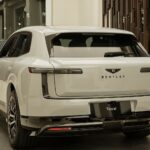
Electric Defender confirmed for 2027
Balaji says the battery-electric Defender will go on sale next year, sold alongside the existing combustion-engined Defender rather than replacing it. That is a significant point. Land Rover is not retiring the petrol and diesel Defender to make room for an EV; the two will share showroom space, at least initially.
The new model will have a smaller footprint than today’s five-door Defender, which points to a different kind of customer. Where the Defender 110 has become a large, expensive family machine, the electric car will be more compact and easier to place on a narrow street or in a multi-storey car park.
It is expected to be JLR’s fifth electric vehicle, joining the Range Rover GT, the electric full-size Range Rover and Range Rover Sport, and the Jaguar Type 01. The Jaguar I-Pace, the car that started JLR’s electric story, is now discontinued.
Defender Sport: what the spy shots show
Prototypes caught testing have been widely referred to as the “Defender Sport”, and the images suggest a car considerably smaller than the current five-door. The proportions look more urban-friendly than the full-size Defender.
That does not mean Land Rover is building a soft-roader. The Defender badge carries expectations, and the boxy silhouette visible under camouflage suggests the design team is keeping the rugged, upright stance that separates the model from everything else in the segment. The question is how much of the off-road hardware survives the shrink.
The shrinking footprint also matters for another reason: it puts the new Defender in the space currently occupied by two models that are leaving the line.
Under the skin: 800-volt EMA platform
The Defender EV will be the second model on JLR’s new Electrified Modular Architecture, or EMA. The platform runs at 800 volts, which brings faster charging and greater efficiency than the 400-volt systems used on most current EVs. The first car on EMA is the Range Rover GT, due to be revealed within a couple of months.
The Defender will share its battery pack with the Range Rover GT. JLR says that pack offers up to 450 miles of range on the WLTP test cycle used in Europe and the UK. Do not expect the Defender to match that figure. Its boxier shape will cost it aerodynamically, and the official number will almost certainly be lower once the car is tested in its own right.
Sharing a pack across two very different vehicles is a sensible piece of industrial logic. It spreads development cost, simplifies the supply chain, and gives the Defender a proven energy storage system from launch.
Built at Halewood, taking over from the Evoque and Discovery Sport
Production will take place at Halewood in England, and the significance of that goes beyond another model line. The new Defender takes over the production slot currently used by the Range Rover Evoque and the Discovery Sport.
JLR has confirmed that the Range Rover Evoque and Velar will be axed in mid-2027, retiring the two models that made the Range Rover badge attainable for a generation of buyers. The Defender EV occupies the manufacturing capacity those cars leave behind, though it will not replace them in the market: it is expected to cost far more, so Evoque shoppers will not find a direct swap waiting for them.
For Halewood, the switch is a statement of intent. The plant moves from building entry-level premium SUVs to building a vehicle positioned firmly in the upper reaches of the market.
Hybrids will follow, but not until 2028
The electric Defender will not be the only powertrain option forever. Hybrid versions are in development. Balaji said the hybrid programme is “fully underway” but confirmed it “won’t catch next year’s timelines”, meaning 2028 at the earliest.
That sequencing is worth noting. JLR is launching the EV first and adding combustion-assisted variants later, which is the reverse of what most manufacturers have done. It reflects confidence in the electric proposition, or at least a willingness to lead with it.
Pricing and positioning: close to the Defender 110
No pricing has been revealed or even hinted at officially. Industry expectation, reported by Automotive News, points to a figure fairly close to the current Defender 110, which would put it well above the Evoque and Discovery Sport it follows down the line. That is reported expectation rather than a confirmed figure, so treat it as a guide only.
That fits a clear pattern. JLR is moving upmarket and away from entry-level luxury, and the new Defender is priced accordingly. Buyers hoping for a cheap electric Land Rover should adjust expectations now.
Land Rover’s options list can also add serious money to any Defender, and there is no reason to think the electric car will be treated any differently. The Atlas paint range is a good example of how quickly the bill climbs once personalisation begins.
Defender as a brand in its own right
This is the part of the story that matters most in the long run. The electric Defender is the first in a proposed series of models intended to establish Defender as its own brand within Land Rover, part of JLR’s House of Brands strategy first reported in 2023.
Under that plan, Range Rover, Defender, Discovery and Jaguar each become distinct marques with their own identities, model lines and marketing. The Defender badge stops being a trim level in the Land Rover range and becomes a brand with a family of vehicles beneath it.
The strategy carries risk. Splitting a single marque into four requires each one to justify its existence, and Defender is the most natural candidate because it already has the strongest standalone identity. It also has the most to lose if the expansion dilutes what made it distinctive.
Treat the 2027 date with some scepticism
JLR has a track record on EV timelines, and it is not a strong one. The Range Rover Electric was officially revealed in September, two years after its original planned on-sale date. The fifth-generation Range Rover was first revealed at the end of 2021, and the electric version has taken considerably longer to arrive than originally indicated.
That history does not mean the 2027 Defender date is wrong. Balaji’s confirmation is more specific than most statements from the company, and the Halewood production plan is well advanced. But buyers planning around a 2027 purchase should build in some slack, and anyone weighing up the current Defender against waiting for the electric car should remember that the combustion model will remain on sale alongside it.