
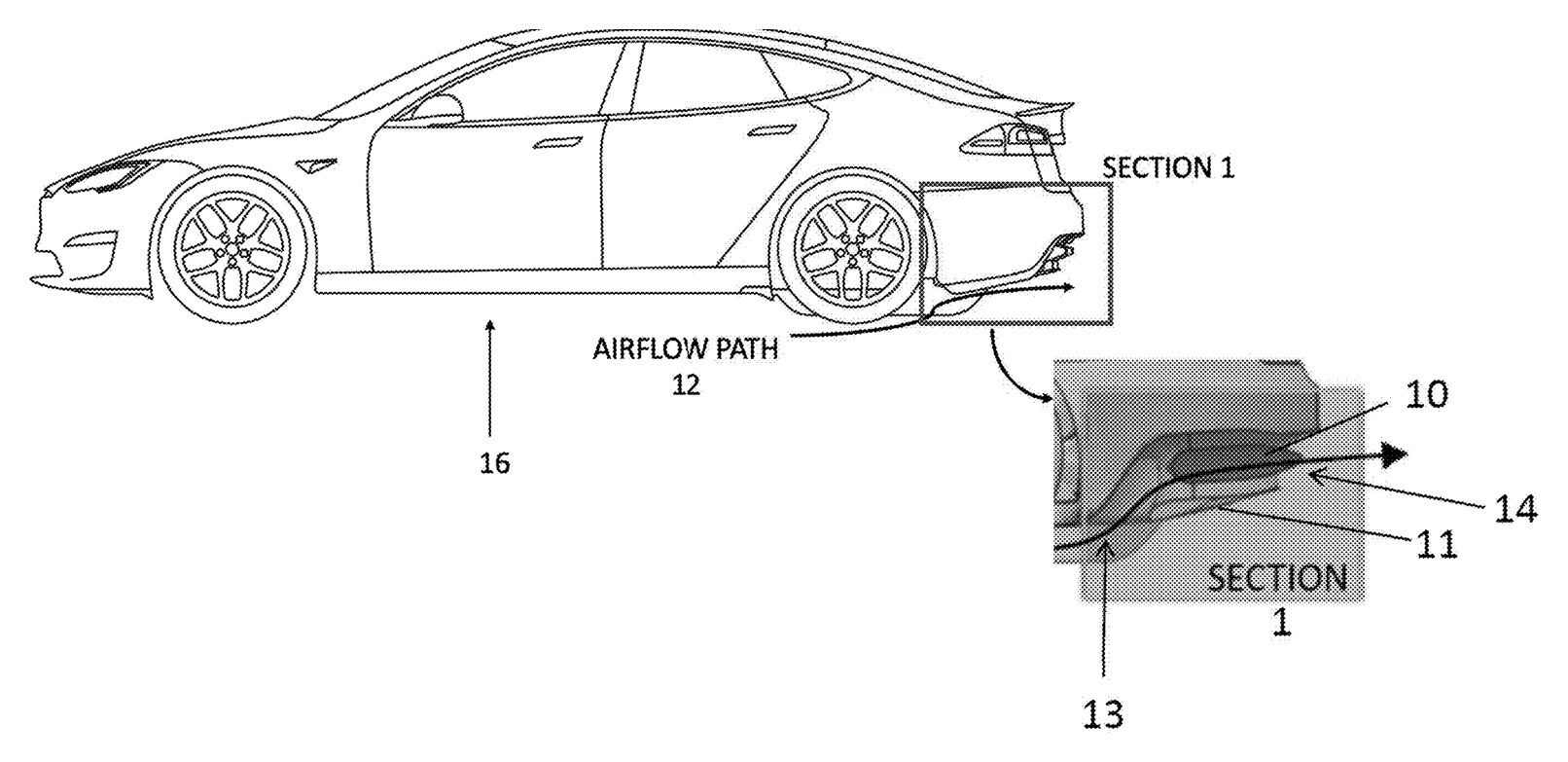
Tesla has never been shy of a wild idea, but its latest granted patent reads like something lifted from a 1970s Can-Am grid. The company has secured US protection for what it calls an “Electric Fan Car”: four electric ducted fans buried in the rear diffuser that spin fast enough to suck the car onto the tarmac. The paperwork landed at the United States Patent and Trademark Office under number US 12,746,987 B1, and the timing is hard to ignore. It arrives roughly two weeks before Tesla’s planned Roadster reveal on 15 October, the car its own engineers have billed as the last great driver’s machine the company will ever build.
What Tesla has actually patented
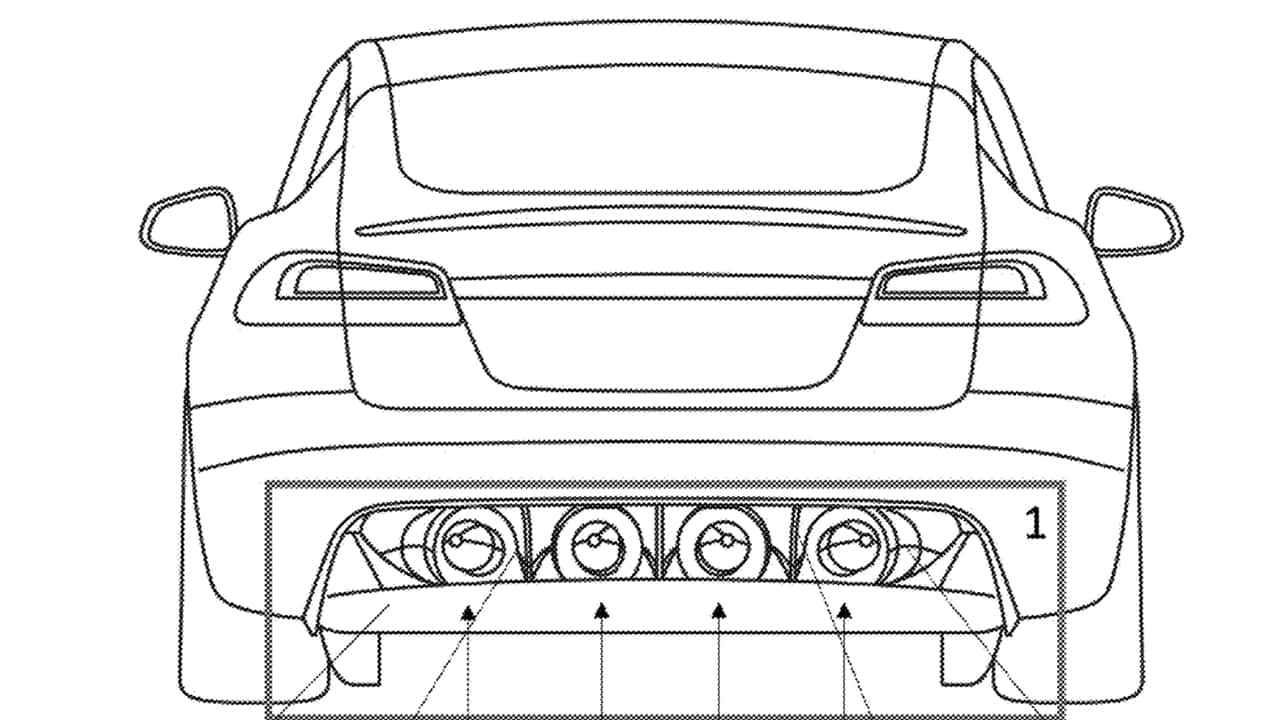
The patent, filed in January 2024 and tracing back to a provisional application dated 17 January 2023, describes an inlet on the underbody between the rear wheels. That feeds a duct sweeping up to a wide outlet cut into the rear diffuser, where four axial fans sit side by side, separated by three vertical strakes.
Spin those fans and they evacuate air from beneath the floor, exhausting it out the back. The result is what Tesla calls a “suction region” under the car, in effect a low-pressure zone that pulls the body downwards. A raked plate at the rear acts as a second diffuser to reinforce the effect. The filing’s own summary is blunt about the goal: “An electric vehicle comprising a ducted fan system configured to increase downforce and reduce drag.”
Eight inventors are named, and all but one are based in the Los Angeles area, home to Tesla’s design studio in Hawthorne. This is not a stray idea from a supplier or a defensive filing by an outside party. It came from inside the building.
Why fans beat wings at low speed
Conventional aero is a compromise. A passive diffuser generates very little downforce in slow corners, when you actually want it, and Tesla notes that a big wing “often results in an excessive load at a high speed,” which means drag, which means range lost and top speed blunted.
Tesla’s claim is that the fans “can produce a downforce independent of the vehicle velocity.” That is the whole appeal. Suction does not care how fast the car is travelling, so the benefit shows up where road cars rarely get it: braking stability and cornering speed at ordinary speeds, without paying a permanent drag penalty for a wing you only need occasionally.
The packaging trick and the backwash problem
The cleverest part of the patent is what it avoids. Tesla says the system works “without use of additional elements below the vehicle,” meaning no skirts sealing the car to the ground. Fan cars of the past relied on flexible skirts to trap the low-pressure zone, which is precisely why they were never road legal. Packaging the hardware into a normal-looking diffuser keeps ground clearance and kerb-friendly geometry intact.
There is a catch, and Tesla admits it. The central inlet tends to pull air forward from behind the car rather than from under the floor. That backwash adds no downforce, so the fans end up “wasting power” on air that does nothing useful. The fix, described in a second version of the system, is to add two smaller side inlets behind the main one to feed the fans from a more productive source.
How it would work on the road
Power comes from the same high-voltage pack that drives the wheels, with the fan system tied into the car’s control architecture. The driver can switch the fans on with a button, or the car can activate them automatically at certain speeds. That is a notably different proposition from a race car, where the fan is either on or the driver is in trouble. Here it reads like another driver mode, sitting alongside launch control and track settings.
Whether owners would notice the difference in a car park is another matter. The real-world payoff is more likely to be confidence under braking and a flatter feel through quick direction changes than any measurable lap time.
The drawings point at a Model S, the timing points at the Roadster
The patent diagrams show a fastback silhouette with a Model S roofline, taillights, lip spoiler and door handles all identifiable. That is an odd choice given Tesla has reportedly ended Model S and Model X production after 14 years and is converting the Fremont line to build Optimus robots. That production stop has not been confirmed by Tesla, so treat it as reported rather than settled. Patent drawings are frequently recycled, so the body in the figures should not be read as a production plan.
The calendar is more telling. A filing granted two weeks before a Roadster reveal, following a separate Tesla patent for a hidden active rear wing producing up to 700 kg of downforce and drawn on a car resembling the new Roadster, starts to look like a package. Fans plus an active wing would amount to a full track aero kit, and the Roadster is the only remaining candidate in Tesla’s pipeline.
Tesla has already described the Roadster as the swan song for human-driven Teslas. Top engineer Lars Moravy called it the “last, best driver’s car” the company will ever make. Elon Musk has claimed it will hit 60 mph from a standstill in under a second. Buyers have been able to put money down again, with Tesla Roadster Reservations Reopen: $50K Deposit, 2026 Reveal, and Musk’s Wild Claims confirming a two-step reservation structure for US buyers.
A second fan patent in just over a year
This is not an isolated filing. In August 2025, Tesla was granted a patent for underbody fans combined with deployable skirts, a more aggressive take on the same physics. Two approaches in little over a year suggests the idea is being explored from more than one angle inside the Hawthorne studio rather than parked as a defensive land grab.
It also puts Tesla in unusual company. The regulatory backdrop for performance EVs is shifting, with US Slashes Fuel Economy Rules: 34.9 mpg by 2031 as CAFE Credit Trading Axed replacing the Biden-era push toward a 50 mpg fleet average. That is a US story, but it shapes the market Tesla sells into, and a drag-heavy, downforce-heavy halo car is a slightly easier sell against a looser efficiency backdrop than it would have been three years ago.
From Chaparral to Goodwood
Fan cars have a rich and slightly cursed history, and it runs straight back to that Can-Am image. Chaparral raced the 2J in 1970 with two fans driven by a separate snowmobile engine, a car built for the no-holds-barred Can-Am series. Brabham’s BT46B won the 1978 Swedish Grand Prix in the hands of Niki Lauda and was withdrawn immediately afterwards, the victim of rival protests. Gordon Murray, who worked on that Brabham, later put a 400 mm fan on the rear of the T.50 road car.
The modern benchmark is the McMurtry Spéirling, which set an all-time Goodwood hill climb record in June 2022, roughly seven months before Tesla’s provisional application. It produces 2,000 kg of downforce at standstill, has been driven upside down, and runs its fans off the main battery, exactly the architecture Tesla describes. McMurtry began production of the Spéirling PURE earlier this year at a price of roughly £1m, so the concept is now a purchasable, if spectacularly expensive, reality.
What the patent does not prove
Car companies patent ideas routinely, and a granted patent is no guarantee of production. There is no word on whether Tesla will build the system or which car would receive it.
There is also a technical objection worth taking seriously. Commentary from Electrek questions the patent’s claim of no separate motor for the fans, noting that each fan would likely need its own motor, controller and sensors to match air draw to vehicle speed. That is four motors, four controllers and a control problem, all packaged in a diffuser. Tesla’s own backwash admission shows the company is aware the system is not simply a case of bolting on fans and hoping.
The wider context is that Tesla is spreading itself across a lot of ground. Alongside a six-figure halo Roadster, the company’s rivals are pushing the other way on price. Rivian, which made its name with the premium R1T and R1S, is now working on affordability, as Rivian R3 and R4: How the EV Startup Plans to Slash Prices Below the R2 sets out.
Suction, showmanship and the Roadster question
A fan car is the kind of idea that only makes sense on a flagship. It is expensive, it is complex, and it solves a problem most EVs do not have. But it is also the most direct answer available to the question of how you make a two-tonne electric car feel like a proper driver’s machine: you glue it to the road with air.
Tesla has spent years promising that the Roadster will be something other than a fast appliance. Four ducted fans and a hidden active wing would be a genuinely novel way to deliver on that. Whether it reaches a showroom is another matter entirely. For now, Tesla has the paperwork, the timing and the history books to draw on. The tarmac, as ever, will be the judge.





One Comment