
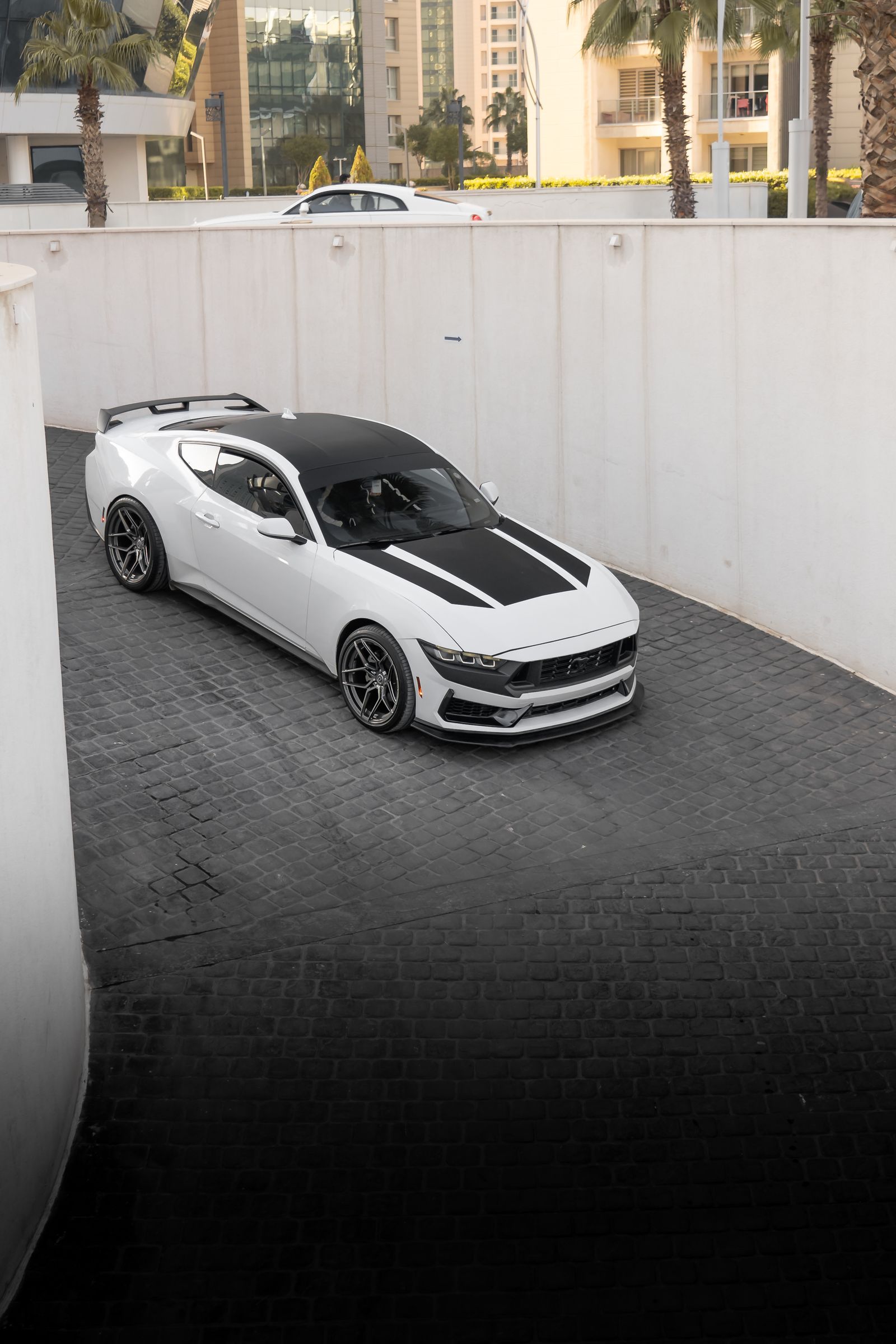
Why the new halo Mustang isn’t a Shelby
The obvious question is why Ford has not simply revived the GT500 name. The answer sits with how Ford Performance now positions its motorsport activities. The company has been emphasising its Ford Racing and Mustang Racing efforts, and there are no racing Shelbys in that stable. Instead, the competition Mustangs carry the Dark Horse name, from the Dark Horse R through to the Mustang GT4 and Mustang GT3. All of those cars were developed by the same Ford Racing engineering team, so keeping the new range-topper within the Dark Horse family gives the badge a coherence it would otherwise lack.
That is a notable shift in how Ford markets its fastest road cars. The Dark Horse name arrived with the S650 generation as a track-focused variant, and it has now been elevated to halo status. Anyone who has followed Ford’s special editions will know the company enjoys this kind of storytelling, and the Mach 1 Twister Special is a reminder that Mustang special editions have always carried their own mythology. The Dark Horse SC is clearly intended to build a similar legend.
Powertrain: a supercharged Predator with GTD DNA
Under the bonnet sits the familiar 5.2-litre double-overhead-camshaft 32-valve V8, known internally as the Predator. It is the same engine family used in the GT500, the F-150 Raptor R and the Mustang GTD, but here it produces 795bhp and 895Nm of torque, or 660lb-ft in the figures Ford quotes. That is a meaningful step up from the GT500’s 760bhp and 847Nm (625lb-ft).
The extra output comes largely from the blower. Ford has fitted the same Eaton TVS R2650 supercharger used in the GTD, but with a smaller-diameter pulley that spins it faster. Peak boost rises to 0.94 bar, up from 0.83 bar in the GT500. An oxygen system has been added to keep the car emissions compliant, which matters given the tightening regulatory environment around high-output V8s.
Power goes to the rear wheels through a Tremec seven-speed dual-clutch automatic and an electronically controlled Torsen limited-slip rear differential. The redline sits at 7500rpm. It is a drivetrain built for both drag strips and road courses, which is exactly the brief the Dark Horse SC appears to have been given.
Chassis, brakes and aero
Ford has overhauled the MagneRide adaptive dampers, upgrading from supplier BWI’s third-generation system to a fourth-generation setup. There is separate calibration for the base car and the Track Pack, which matters because the two versions are aimed at different buyers.
The Track Pack is where the GTD hardware really shows through. It adds carbon-ceramic brakes measuring 419mm at the front and 371mm at the rear, carried over from the GTD, along with carbon-fibre wheels. Ford says the package cuts around 68kg, roughly 54kg of which is unsprung and rotating mass. That is the kind of reduction you feel through the steering and over kerbs. The standard car makes do with iron rotors but keeps the same piston counts: six at the front and four at the rear.
Track Pack cars also get a slightly stiffer suspension setup, half-inch wider wheels, an adjustable rear wing, customer-installed wicker-like front splitter appendages, teal brake calipers and matching interior accents including seat belts. The rear bench seat is deleted. Tyres are Michelin Pilot Sport Cup 2 R in 305/30R20 at the front.
Aerodynamics have been taken seriously too. Ford quotes total negative lift of 281kg at 180mph (290km/h), with rear downforce exceeding front, which produces mild increasing high-speed understeer. A larger bonnet heat-extraction vent, complete with a removable rain tray for track use, reduces lift on the underside of the bonnet and channels heat out of the engine bay. The S650 nose feeds an auxiliary radiator and oil cooler through outboard front-bumper cut-outs.
Perhaps the most interesting carryover is the speed-dependent variable traction control system developed for the GTD. It offers five levels of intervention, letting the driver dial in how much slip they want before the electronics step in.
How fast is it?
Ford has not quoted an official 0-60mph time, and there is no 0-62mph figure either. US outlet Road & Track suggests roughly three seconds to 60mph is possible with launch control and a good hook-up, which would put it firmly in supercar territory.
Drag strip runs at Sonoma Raceway in California produced quarter-mile elapsed times ranging from the low 11s to the high 10s, with trap speeds in the low-to-mid 130s mph. Road & Track recorded a 130mph trap. For reference, Car and Driver’s best GT500 time was 11.3 seconds at 132mph, and it expects the SC to run in the high 10s at a slightly higher trap speed. The new car is quicker, then, but the margin is measured rather than dramatic. The bigger gains appear to be in how it puts its power down and how it behaves on a circuit.
Behind the wheel
Early testers have been generous with their praise. The revised MagneRide has been singled out for controlling body motion while still riding well, and the nervousness and tram-lining that characterised the old S550 and Shelby cars is reportedly gone. The Dark Horse SC stays composed on lumpy Napa Valley roads and over Sonoma’s kerbs, which is no small achievement for a car weighing 1,864kg.
The steering has been described as the best of any S650 Mustang, with a lighter front-end feel than the car’s size suggests and a neutral balance for a front-engine machine. The cabin is function-first, with strong S550 DNA throughout. Car and Driver noted that both the base car and the Track Pack worked well on the street, which is not always a given for this class of car.
Then there is the noise. The active exhaust has Quiet, Normal, Sport and Track modes, and engineers deliberately made it louder than the GT500. In Track mode it reportedly bellows like a full-race V8. Testing was split between Sonoma Raceway, where the car ran both the drag strip and the road course, and the roads of Napa Valley in California. That mix of venues tells you what Ford was aiming for: a car that can lap hard and then drive home without complaint.
Pricing and positioning
In the United States, prices start at $108,085 including a $2,600 gas guzzler tax, rising to $144,585 for the Track Pack and $175,565 for the Special Edition, with the Mustang GTD above it at $325,000. Those are US figures only, and Ford has not confirmed UK availability or pricing.
The positioning is clear enough, though: the Dark Horse SC is the attainable halo car, the GTD is the extreme, limited-run flagship, and the standard Dark Horse and GT models fill out the rest of the S650 range. Whether any of that structure ever applies to a right-hand-drive car is another matter entirely.
A new benchmark for the modern pony car
The Dark Horse SC is the most complete performance Mustang Ford has built in the modern era. It takes the supercharged V8 muscle that made the GT500 such a favourite, adds the carbon brakes, blower and traction control software from the GTD, and wraps it all in a package that testers say is genuinely usable on the road. The fact that it does all this without a Shelby badge is significant, and it underlines how far the S650 platform has evolved from the S550 that launched as a 2015 model and went on to spawn the Bullitt, Mach 1, GT350 and 760bhp GT500.
Ford’s decision to develop the Dark Horse SC alongside the GTD explains much of what makes it special. Shared parts including the duckbill spoiler, carbon brakes and traction control software would not have been possible otherwise. It is also a reminder that motorsport programmes shape road cars in ways that are not always obvious to buyers. The Dark Horse name now carries real weight, and the SC gives it the flagship it needed. For anyone who feared the supercharged Mustang was a thing of the past, this is a reassuring answer. The formula has not been abandoned. It has simply been renamed.




2 Comments