
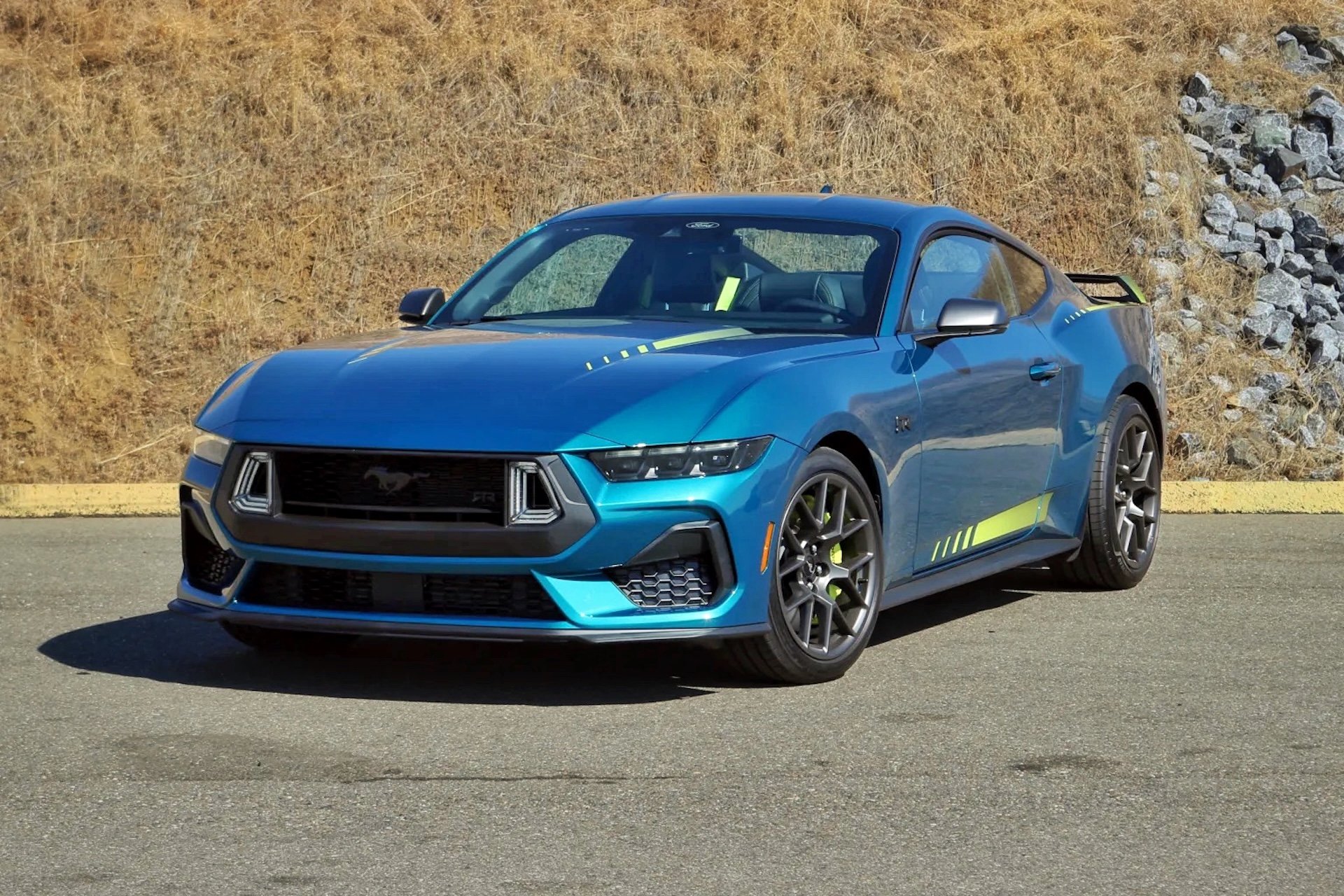
What the Mustang RTR actually is
RTR stands for Ready to Rock, which tells you most of what you need to know about the company behind this car. Founded by drifter Vaughn Gittin Jr., RTR Vehicles has spent years building modified Mustangs and Broncos, and this is the first time that relationship has produced a factory-backed, showroom Mustang variant.
The crucial detail is what sits underneath. Rather than starting with the 5.0-litre V8, Ford and RTR began with the entry-level 2.3-litre EcoBoost Mustang. That places the RTR below the V8 Mustang Dark Horse in the range, and it is priced accordingly. This is not a stripped-out competition car either. It is a road-legal machine built specifically for going sideways, though Ford notes it can be developed into a race car if that is your ambition.
Anti-lag from a GT race car
The engine itself is unchanged. You get 315bhp at 5,500rpm and 475Nm of torque at 3,000rpm, exactly as in the standard EcoBoost. What Ford has added is an anti-lag system it says was derived from its GT race car. On lift-off, the engine computer cuts fuel but leaves the electronic throttle open, which keeps the turbocharger spinning so boost builds almost immediately when you get back on the power.
It is the kind of technology that makes a turbocharged four-cylinder feel far more responsive than its spec sheet suggests, and it matters enormously when you are trying to hold a slide. Drive goes through a 10-speed automatic transmission and a Torsen limited-slip differential with a 3.55:1 final drive. In Track mode the gearbox holds the powerband well and downshifts under braking, which is exactly what you want when you are setting up for a corner.
Chassis hardware borrowed from the Dark Horse
The RTR’s real character comes from its chassis. The Ford Electronic Drift Brake, already familiar from the V8 Mustang GT’s optional Performance package, lets you lock the rear wheels independently of the main braking system. MagneRide adaptive suspension arrives with a unique RTR calibration, tuned to make rotating the car easier without wrecking the ride.
The steering rack has nearly 20% more maximum angle than standard, which is the difference between catching a slide and running out of lock. From the Mustang Dark Horse come a rear subframe with stiffer bushings, adjustable strut mounts and stiffer front and rear anti-roll bars from the Dark Horse Handling Pack. There is also the Mustang GT’s more powerful cooling fan, Performance package Brembo brakes with 15.4-inch front rotors and six-piston calipers, an active exhaust and wider wheels with greater offset.
If you want to see where this hardware sits in the wider Mustang hierarchy, our look at the Ford Mustang Dark Horse SC: 795bhp Supercharged V8 Is Ford’s New Halo Pony Car explains how the V8 range-topper fits into Ford Performance’s plans.
On track at Thunderhill
The obvious risk with a drift-focused calibration is that it ruins the car everywhere else. At Thunderhill’s West road course, it did not. The RTR showed excellent grip, genuine stability and eager direction changes, with the multilevel stability control making slides accessible while keeping an electronic safety net in place. Ford’s drive mode calibration allows noticeably more rear-end rotation in Track mode than a typical stability system would permit, but it never feels like the car is trying to bite you.
The lighter EcoBoost engine makes the RTR less insistent about leading with its nose than a V8 GT, and it genuinely enjoys rotating. Compared with the Focus RS’s drift mode, the rear-wheel-drive Mustang is longer and more graceful in the way it transitions, which makes it a more natural platform for provoking oversteer in the first place.
On the road
In Normal mode the RTR is smooth and comfortable, with adaptive dampers that are well judged for imperfect, patchy surfaces. The cockpit stays reasonably subdued on the quietest exhaust setting. The 10-speed automatic upshifts early in the name of fuel economy, which can produce noticeable four-cylinder droning when you are accelerating just below the point where it kicks down.
Switch to Sport and the ride remains tolerable rather than punishing, but the exhaust note gets rougher without ever really sounding like much of anything. That is the trade-off you accept with this engine. Without Sport mode activated, the only obvious tell over a base EcoBoost from inside the car is the Hyper Lime trim.
Weight, price and positioning
In the US, the RTR adds $6,520 over a base EcoBoost, which is US-market pricing with no UK equivalent announced. It also adds roughly 90kg, which makes it nearly as heavy as a zero-option Mustang GT with the 5.0-litre Coyote V8. The saving grace is where that mass sits: lower and further back than the V8’s front-biased weight distribution. That is why the RTR turns in more willingly and feels less nose-led than its V8 sibling, despite giving away two cylinders and a considerable amount of power.
Design and interior details
Visually, the RTR takes the Mustang GT front fascia with illuminated nostrils and adds RTR badges, Tarnished Dark Anodized mirror caps, hood, rocker and rear quarter graphics, the Mustang GT Performance pack rear spoiler and 19-inch wheels. The optional Hyper Lime pack extends to brake calipers, graphics, the drift brake lever trim, seatbelts and stitching, plus RTR sill plates and a dash plaque. If that is too much, Ford offers black seatbelts and grey stitching as a more subdued alternative.
It is a coherent package, and the Hyper Lime accents are the main giveaway that you are not driving a standard EcoBoost. That restraint is deliberate. This is a car that wants to be noticed for how it drives rather than how loudly it announces itself.
A more attainable route into Mustang performance
The Mustang RTR is not a dedicated drift car and it is not a race car, even though it can be turned into one. It is a road-legal machine built around sideways fun, and it succeeds at that without making everyday driving a chore. The anti-lag system gives the four-cylinder an urgency its power figure does not suggest, the extra steering lock and Dark Horse chassis parts make sliding feel natural rather than intimidating, and the lower, further-back weight distribution gives it a balance the V8 GT cannot quite match.
What it does not have is a soundtrack, and the 10-speed automatic’s economy-biased upshifts can leave the engine droning at exactly the wrong moment. Those are real compromises. But if you want the Mustang experience without V8 running costs, and you value handling balance over outright muscle, the RTR makes a persuasive case. It is the entry point to Mustang performance, reworked by people who spend their lives making rear-wheel-drive cars dance on purpose.
For a look at how another manufacturer is approaching the hot hatch end of the performance market, our coverage of the 2027 Honda Civic Type R Facelift Revealed: Heated Seats, Retuned +R Mode and a Sharper Front End shows that not every performance update needs more power to be worthwhile.
We covered ford bronco rtr pricing in more detail elsewhere.





3 Comments