
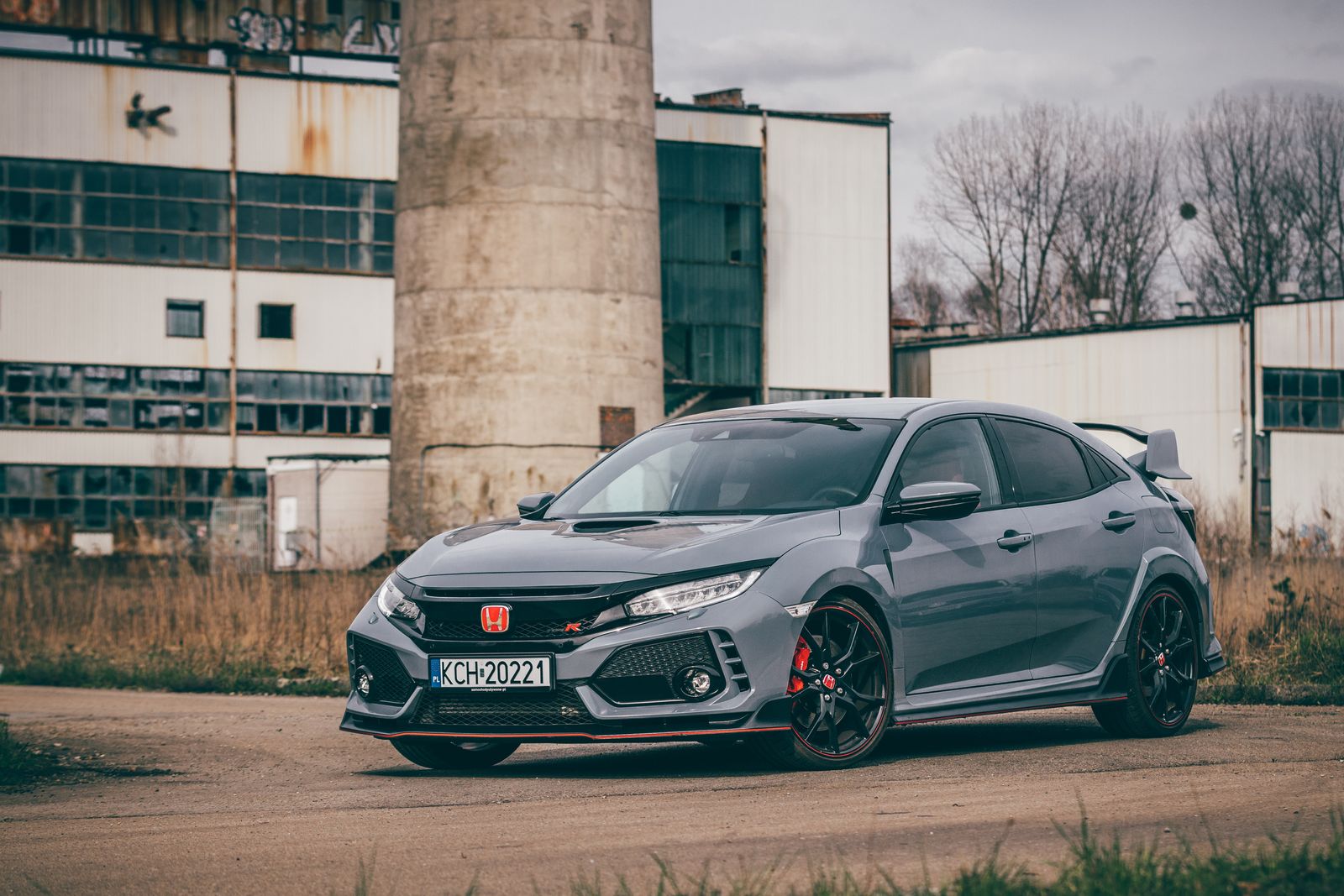
Honda has revealed a facelifted 2027 Civic Type R, and the changes are modest, targeted and entirely familiar to anyone who has followed the FL5-generation car. There is no power increase, no new chassis architecture and no headline lap time. Instead, Honda has addressed the criticisms that have trailed the current model since launch: a brittle ride in its stiffest setting, a brake pedal with a little too much slack, and a cabin that felt spartan next to premium rivals. The 2027 car goes on sale at US dealerships later this month, with pricing confirmed at $49,990. This year also marks a decade of Civic Type R sales in the US and 30 years of the badge globally.
A sharper nose and a more compliant +R mode
The most visible change is up front. Honda has revised the front fascia with what appears to be a larger grille aperture, feeding more air to the engine bay, while a deeper front splitter increases downforce and reduces turbulent air. Both changes are about cooling as much as looks, which matters on a turbocharged 2.0-litre four that works hard on track days.
Under the skin, the more interesting work concerns the +R driving mode. Honda has retuned it for greater compliance, dialling back the bouncing and impact harshness that made the stiffest setting a chore on imperfect surfaces. The pay-off is said to be greater stability and improved road following, which is engineer-speak for a car that tracks a cambered road rather than skipping across it.
Brake feel has also come in for attention. Honda has added a yoke spring to the brake pedal assembly, removing play for a more direct, linear response. It is the kind of change you notice in the first hundred yards, particularly on a car with this much stopping power. The rev-match system has been sharpened too, responding faster for smoother downshifts.
And yes, the six-speed manual gearbox survives. In a market where the manual is under steady threat, that remains the Type R’s calling card.
Heated seats return, and the cabin grows up
The heated seats are back for the first time since the FL5 Type R launched, and their absence had become a genuine sticking point for buyers cross-shopping premium metal. Honda has also revised the perforation pattern on the suede-style upholstery to reduce sliding around in corners, a small change that will be appreciated on track.
Material quality takes a step up as well. Ultrasuede now covers the instrument panel and upper front door panels, while the aluminium shift knob and door handles move to a darker grey finish. The climate control and air vent knobs are painted black, and an auto-dimming rear-view mirror is now standard. Infotainment gains built-in Google and Alexa, which brings the Type R into line with the wider Honda range.
Honda Sensing gets smarter
The driver assistance suite has been updated too. Honda Sensing now includes Post-Collision Braking, a system designed to limit damage in multi-collision crashes by applying the brakes after an initial impact to stop the car travelling into further hazards. It is the sort of feature you hope never to need, but it reflects how safety regulation and customer expectation have moved on since the FL5 arrived.
New colours and a nod to JDM history
Paint options now include Meteorite Grey Metallic, joining Boost Blue Pearl, Sonic Grey Pearl and Honda Championship White. Under the bonnet, Honda has redesigned the engine cover in a style said to evoke the early JDM Type Rs, a small piece of fan service for the enthusiasts who have kept the badge alive for three decades.
US pricing, and what it means for the Integra
Stateside, Honda lists the 2027 Civic Type R at $49,990, up from $48,690 the previous year. Car and Driver reports the same figure, and we are going with it. Hagerty has quoted $48,695, which appears to be an error rather than a competing price.
The broader positioning is interesting. Car and Driver argues that the improvements, heated seats in particular, make the mechanically related Acura Integra Type S a harder sell. When two cars share a platform and a powertrain, the one with the better-equipped cabin and the sharper chassis tuning tends to win the showroom argument. It is a theme that has cropped up repeatedly this year, from Acura Pauses MDX Type S Production: What the US Performance SUV Shake-Up Means for UK Drivers to the wider reshuffling of performance line-ups across the industry.
Honda’s decision to keep investing in the Type R also sits against a backdrop of shifting manufacturer priorities. Rivals are hedging their bets on powertrains, and the industry news cycle has been dominated by brands rethinking their electrification timetables, as covered in our round-up of how Nissan Bets on Hybrids, Tesla Wins More European FSD Approvals, Volvo Freezes Hiring. Against that uncertainty, a manual-only, petrol-powered hot hatch with a retuned chassis feels almost defiant.
Honda’s motorsport arm remains busy too, with the brand’s racing commitments extending well beyond the showroom. The company confirmed this week that Christian Lundgaard Signs Multi-Year Chip Ganassi Racing Deal for 2027 IndyCar Season, putting the Dane in the #9 PNC Bank Honda from 2027. A strong racing programme and a strong Type R badge have always fed each other.
Three decades of the red H
Thirty years is a long time for any performance badge, and the Type R has outlasted most of its rivals by staying stubbornly true to a formula: front-wheel drive, a high-revving turbo four, a limited-slip differential and a manual gearbox. The 2027 facelift does not rewrite that formula. It sands down the rough edges that had crept in, restores equipment that should never have been dropped, and sharpens the controls that matter most.
The heated seats, the more liveable +R mode and the improved brake feel will not make headlines, but they make the car easier to live with, and that is exactly what a facelift should do. The manual survives another year. Long may it continue.
Related: honda civic type sharper.
Related: jaguar type lotus britain.





2 Comments