
September’s new car market delivered a jolt that few forecasters saw coming. More than 350,000 cars were registered last month, a jump of over 12 per cent year on year and the strongest September since 2017. The headline number only tells part of the story. Look beneath it and the real news is about who is selling those cars.
A market finally back on its feet
For years, the new car market sat below its historic watermark. Pandemic disruption gave way to a cost of living squeeze that kept buyers away from showrooms, and registrations never quite recovered the ground they lost. September’s figures, published by the SMMT, suggest that spell is over. Passing 350,000 units in a single month is volume the industry once treated as routine, and its return signals that consumer confidence has genuinely thawed.
That the recovery coincides with a new registration plate is no accident. The 76 plate gives dealers a fresh reason to get buyers through the door, and September has long been one of the two biggest months of the year for exactly that reason. What is different this time is who is cashing in.
The Jaecoo 7 phenomenon
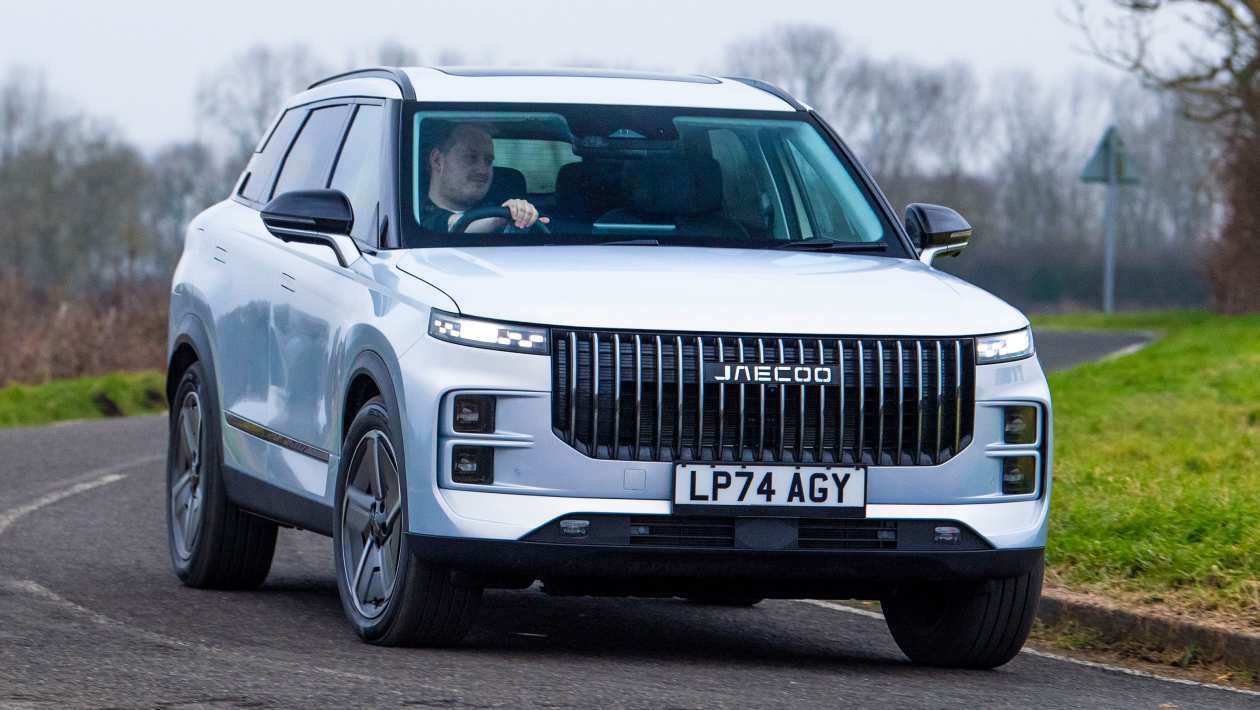
The most popular car on the 76 plate was not a Ford, a Vauxhall or a Volkswagen. It was the Jaecoo 7, a family SUV from a brand that only began selling in the UK last year, with roughly 10,800 registrations in September alone. Across the first nine months of the year, almost 39,500 Jaecoo 7s have found homes, making it the second-best selling car of the year so far.
For a marque with no heritage in Britain, no legacy dealer network and no decades of brand equity to lean on, that is a remarkable ascent. The Jaecoo 7 has picked up the nickname “the Temu Range Rover” online, a label that captures both its upmarket styling cues and its aggressive pricing. The registration figures say something louder than any nickname.
Chinese brands are rewriting the pecking order
Jaecoo now holds 3.4 per cent of the overall UK market, putting it ahead of Renault, Volvo, Honda and Cupra. That is not a niche position. It is a mid-table share achieved in roughly a year of trading.
The picture sharpens further when Jaecoo is combined with its sister brand Omoda. Together, the two Chinese newcomers outsell Ford and Audi combined. Ford has been a fixture at or near the top of the UK sales charts for generations, and Audi has spent decades building a premium position. Being out-sold by a pair of brands that most British drivers had never heard of two years ago is a genuine structural shift, not a seasonal blip. Chinese manufacturers are expanding aggressively across global markets, and the question of where they build next is already being asked, as Nissan Warns Chinese Car Brands Will Build in Mexico Within Three Years.
What the industry makes of it
Philip Nothard, insight director at Cox Automotive, was blunt about the significance of the moment. “The increasing influence of Chinese manufacturers is impossible to ignore,” he said. “Their growing presence is stimulating competition and a greater range of consumer choice. It is also intensifying pressure on established brands, especially as the industry continues to work towards increasingly demanding EV targets.”
That framing matters. Chinese competition is not simply undercutting prices. It is adding choice, which is good news for buyers, while simultaneously squeezing the margins of brands that must also fund the transition to electric vehicles. The pressure is coming from two directions at once.
Electrified cars now dominate
The powertrain mix in September shows how far the market has moved. Electric cars took 28 per cent of registrations, while hybrids and plug-in hybrids combined accounted for 30 per cent. Add those together and electrified vehicles now make up more than half of all new cars sold in the UK. That shift is visible in the concept cars too, from mainstream reinterpretations to more unusual experiments. The Renault 8 Gordini Concept: Electric Reinvention of a French Rally Icon shows how even heritage models are being reworked around battery power, while schemes like Witkar: The 1970s Amsterdam Electric Car-Sharing Scheme That Was Decades Ahead of Its Time remind us that the idea of electric urban mobility is far from new.
Petrol’s share fell sharply, from 45 per cent in September last year to 38 per cent. Diesel held steady at four per cent, a reminder that it remains a small but stubborn slice of the market rather than disappearing entirely. The direction of travel is unmistakable, and the momentum is with electrified options.
The SMMT’s verdict
Mike Hawes, chief executive of the SMMT, described the progress as a “major achievement”. “Drivers are increasingly embracing the growing choice of models made available and high fuel prices are also undoubtedly giving more consumers reason to consider going electric,” he said. “The industry’s commitment is clear with billions of pounds of investment in new models, new technology and incentives.”
The point about fuel prices is worth dwelling on. With petrol and diesel costs remaining a live concern for households, the running cost case for electric motoring has become more persuasive for ordinary buyers, not just early adopters. Combined with a wider range of models at more accessible price points, that is translating into showroom traffic.
The ZEV Mandate problem
Yet the market is still not where the Government wants it. Under the ZEV Mandate, manufacturers must ensure a third of their sales are full electric vehicles in 2026 to avoid fines. At 28 per cent, the market is short of that threshold.
To close the gap, manufacturers have been discounting heavily, a practice the industry regards as unsustainable. Even with those incentives, many are struggling to comply. The Government has hinted it will relax certain elements of the Mandate, while holding firm on the 2030 phase-out of pure petrol and diesel cars and the 2035 deadline for hybrids.
Hawes framed the review as “an opportunity to review those factors, to build on this momentum and support consumers but, in doing so, strengthen business viability and UK competitiveness”. The balancing act is delicate: keep the transition moving without asking manufacturers to absorb losses they cannot sustain.
What happens next
Three things are worth watching. First, whether September’s momentum carries into the final quarter, or whether it proves to be a plate-change spike rather than a genuine recovery. Second, how the Mandate review lands. If the rules are softened, it could ease pressure on manufacturers in the short term, but the 2030 and 2035 deadlines remain fixed points that will shape model ranges for years.
Third, and perhaps most significant for buyers, whether the Chinese advance continues at this pace. Jaecoo and Omoda have shown that brand loyalty is far less rigid than the industry assumed, and that a well-priced, well-equipped SUV can win volume quickly. For established brands, that is a warning. For consumers, it is leverage. The near-decade sales high is real, but it is being built on a market where trust is shifting faster than anyone predicted.




2 Comments