How Emergency Drive Away actually works
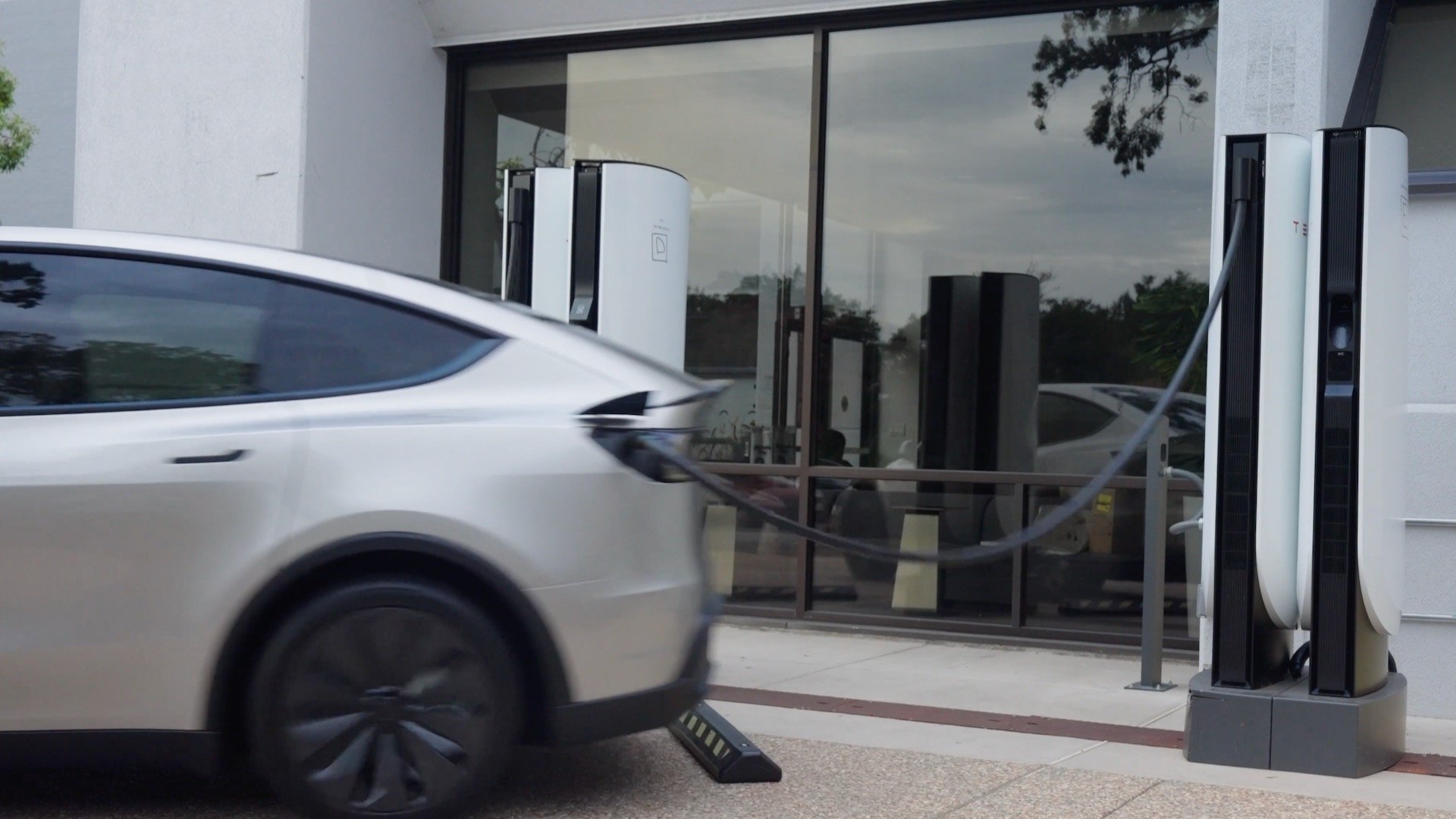
The sequence is deliberately simple, because nobody wants to be reading menus in a crisis. The driver shifts into Drive while the car is still plugged in, an alert appears on the touchscreen, and the driver confirms. The car then pulls away with the connector still attached.
The charging plug is designed to break away rather than hold the car hostage, but “break away” is doing a lot of work in that sentence. In the video Tesla published, slowed down, the motorised charging door goes limp, the Supercharger plug separates from the cable, and coolant can be seen spilling from the severed line. Tesla’s own wording confirms the outcome: the feature is “intended for emergency use only” and “will damage your vehicle and the Supercharger.” Every activation also requires a mandatory service visit to deal with the charge port. Recorded clips of each use are sent straight to Tesla, as the notification in the demo video makes clear.
The $25,000 question, and why Tesla is watching
Tesla puts the cost of repairing a damaged Supercharging stall at up to $25,000, once electrical work and civil engineering are accounted for. That is Tesla’s own approximate US estimate, and it applies to the US network, where this feature is being rolled out. It explains the tone of the company’s messaging. Deliberate misuse will “invoke additional penalties,” Tesla warns, which is corporate language for: we will know, we will have the footage, and we will charge you.
Max de Zegher, Tesla’s senior director of charging for North America, framed the whole thing as a reluctant compromise. “We select Supercharger locations with safety in mind and relocate sites deemed unsafe,” he said. “Our goal is that you always feel safe getting out to unplug.” Then came the admission that this was not an easy decision: “We went back and forth on this for years, but believe offering it is the right call. Don’t abuse it, so we don’t have to restrict it.”
That last line is the tell. Tesla is effectively trusting its own customers with a very expensive lever, and reserving the right to take it away if they treat it as a shortcut for a forgotten cable.
Availability, compatibility and where it works
Emergency Drive Away is rolling out now as an over-the-air update and, according to Tesla’s release notes, requires software version 2026.38.3. Those same notes state that it does not work on pre-2021 Model S saloons or Model X crossovers, so older flagship owners are left out. The feature is also limited to US Superchargers: it will not function at third-party charging stations, and it does not apply to Level 2 Tesla Wall Connectors. That restriction matters, because the feature is tied to the hardware design of Tesla’s own DC rapid charging stalls rather than to the car alone.
The rollout arrives shortly after Tesla released an automatic collision evasion feature the previous month, according to InsideEVs. The company now treats hardware and software as one continuous product, as shown by updates such as the Tesla Model 3 Gets 16-Inch Screen and More Power – But Not Everywhere.
The shooting that prompted it
The feature did not come out of a brainstorming session. Tesla has linked it to a high-profile shooting at an In-N-Out Burger in Twin Falls, Idaho, which spilled over into a nearby Supercharging station. The gunman opened fire on vehicles at the station, including one that could not drive away because it was still connected to a charger.
That is the scenario the feature exists for. Not a forgotten cable, not a hurry, not a queue of impatient drivers behind you. A situation where staying put is genuinely more dangerous than driving off, and where the alternative to a damaged charge port is far worse. Tesla calls it a “peace of mind feature,” and in that specific context the phrase earns its keep.
Years of debate and a robotic arm that never shipped
De Zegher’s comment about going “back and forth on this for years” hints at how awkward the trade-off is for Tesla. The company has a long history of chasing ambitious engineering solutions to human problems, and charging is no exception. It previously developed a robotic charging arm, intended in part to help drivers who struggle with heavy DC rapid charging cables, including disabled drivers, but shelved it after deciding it was too “creepy” for production. The same instinct shows in its more unusual patent filings, such as the Tesla Patents an ‘Electric Fan Car’: Four Ducted Fans Could Suck Its Next Roadster Onto the Tarmac.
Emergency Drive Away is the opposite of those projects. It is not a moonshot. It is an admission that in a small number of situations, the safest thing a Tesla can do is destroy a piece of Tesla’s own infrastructure and worry about the invoice later.
A safety net with a bill attached
There is a genuine tension at the heart of this feature, and Tesla is not pretending otherwise. On one side sits driver safety, which is hard to argue with when the trigger scenario involves gunfire. On the other sits a charging network made of expensive, complex hardware that can be wrecked in seconds by a driver who misreads the situation, or simply decides they cannot wait.
The safeguards are all there: the on-screen confirmation, the mandatory service visit, the recorded clips sent to Tesla, the threat of penalties for abuse. What Tesla cannot do is make the judgement call for the driver in the moment. That is left to the person behind the wheel, who has to weigh a $25,000 repair against whatever is happening outside the car.
For now, the feature is a US-only safety valve on a US-only network, and Tesla clearly hopes it stays a feature nobody ever has to use. The company’s own framing says it best: this is a feature you should never need. If it works as intended, most drivers will never see the alert, never confirm it, and never hear the sound of a Supercharger cable snapping free behind them.
For more on this, see tesla powershare home backup.