
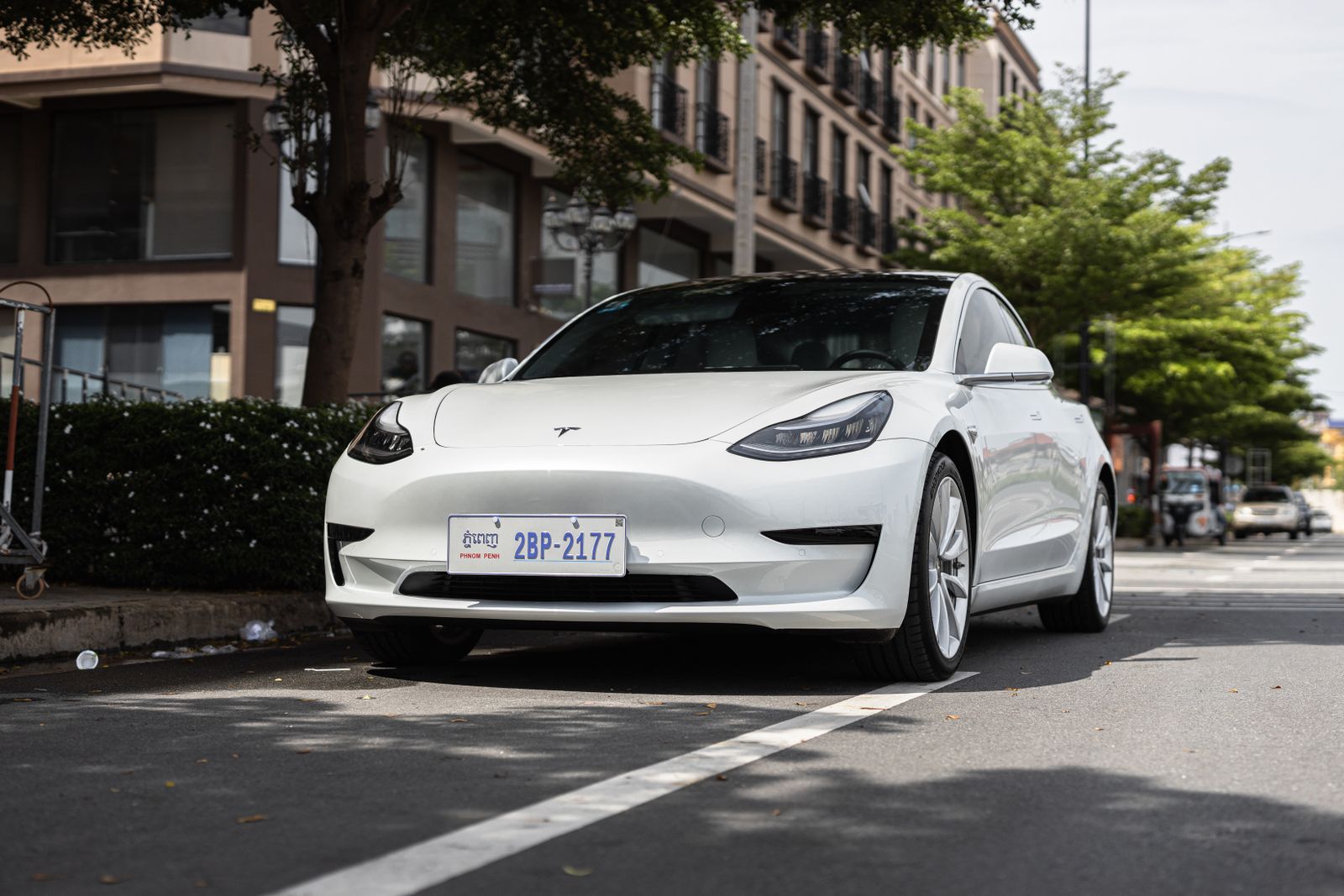
Tesla Expands Powershare to Model 3 and Model Y
The core news is straightforward. Powershare Home Backup, which lets an EV run a house during an outage, is no longer a Cybertruck exclusive. The order-date phrasing matters: this is a promise attached to new purchases, not a retrofit programme.
It also fits a pattern of Tesla spreading capability across its range rather than reserving it for halo products. The company has been steadily updating its mainstream models, as we saw when the Tesla Model 3 got a 16-inch screen and more power, and Powershare is another example of features trickling down from the flagship end of the line-up.
Which Cars Qualify
The order-date cutoff is the detail that will frustrate existing owners. Tesla says that for cars built before 1 October 2026, “some, but not all” Model 3 and Model Y vehicles have the necessary hardware. That is a deliberately vague formulation, and it leaves a large number of drivers unsure where they stand.
Fortunately, there is a way to check without calling anyone. On the touchscreen, go to Software, then Additional Vehicle Information. If “Powershare Support” is listed as enabled, the car has the capability. If it is not there, it does not.
Tesla has not said when the PCS2 Lite inverter, the component that handles bidirectional power flow on the Model 3 and Model Y, entered production on each trim. Without that information, owners of pre-cutoff cars are left checking a menu and hoping. It is not the most elegant rollout, but it is at least verifiable.
Hardware and Installation
Here is where the story becomes as much about Tesla’s energy business as its cars. Powershare on the Model 3 and Model Y requires a Powerwall 3 plus either a Wall Connector or Universal Wall Connector. No Powerwall, no home backup. Tesla says no extra hardware is needed if you already have that combination, but owners must contact Tesla support to have the feature activated.
In the US, a Powerwall 3 runs around $15,000 including installation, with a Wall Connector adding $585. That is a significant outlay, and it means the addressable market for this feature is essentially existing Powerwall 3 households plus new buyers willing to spend five figures on home energy storage alongside their car.
In the US, the Cybertruck’s setup is different and, ironically, cheaper to add. Because it carries an onboard DC-to-AC converter, it needs only a Universal Wall Connector and a Powershare Gateway, sold as a Home Backup Bundle for $1,970. The Model 3 and Model Y, by contrast, lean on the Powerwall to do the heavy lifting. Ford and GM both require a separate inverter and backup hardware too, so Tesla is not alone in demanding extra kit, but its version ties customers more tightly to its own ecosystem than most.
Backup Performance and Output
Tesla’s headline claim is that a Model 3 or Model Y adds “over two days” of backup for a home consuming 30 kWh a day, starting from a 90% charge. Standard trims get “up to two days.” A Cybertruck, with its substantially larger pack, adds more than three days.
On output, the figures circulating differ because they describe different things. The 11.52 kW figure reported by Electrek is the continuous output of the Powerwall 3 setup, while the 15 kW reported by InsideEVs refers to a peak rating. Continuous output is the number that matters for sustained backup, and it is comfortably enough to run essentials and then some, though a home with electric heating or a heat pump will drain the reserve considerably faster than the 30 kWh daily figure suggests.
The two-day framing is sensible marketing. It is long enough to cover the vast majority of grid outages, and it avoids overpromising on the kind of multi-day winter storm scenario where any home battery system starts to look thin.
How Tesla Compares
Tesla is not first here, and it is not even the most generous. Ford launched home backup on the F-150 Lightning back in 2022 with 9.6 kW of output, and the system has become one of the truck’s genuinely useful party tricks. GM committed in 2023 to bringing vehicle-to-home to every Ultium-based EV by model year 2026, and it delivered: GM Energy’s compatibility list now spans the Equinox EV, Blazer EV, Silverado EV, the 2027 Bolt, GMC’s Sierra EV and Hummer EV, and a spread of Cadillacs. Kia offers V2H on the EV9 through a Wallbox bidirectional charger, and InsideEVs lists the Nissan Leaf among EVs that can act as emergency generators.
What sets Tesla apart is not raw capability but integration. GM and Ford require their own inverters and backup hardware, and Kia’s solution leans on a third-party charger. Tesla’s approach runs everything through the Powerwall, which means the car and the home battery are speaking the same language. For a household already invested in Tesla Energy, that is a genuine advantage. For everyone else, it is a reason to buy more Tesla products.
The company’s appetite for unconventional engineering is well documented, from the patent for an electric fan car with four ducted fans to the long-promised Roadster reservations that reopened with a $50,000 deposit. Powershare is a reminder that some of Tesla’s most consequential work happens in the boring middle of the range, not at the exotic edges.
The Long Road to Bidirectional Charging
This feature has been a long time coming. At Tesla’s Investor Day in March 2023, Drew Baglino, then senior vice president of powertrain and energy engineering, said bidirectional charging could arrive “within the next two years,” pointing to 2025. Elon Musk, speaking at the same event, was characteristically blunt: “I don’t think very many people are going to want to use bidirectional charging, unless you have a Powerwall.”
Musk’s prediction now looks rather prescient. Tesla has built Powershare so that it only works with a Powerwall 3, which is either a neat piece of ecosystem strategy or a quiet admission that the hardware was never going to be cheap enough to give away. The intervening years brought delays, including repeated hold-ups before Cybertruck’s Powershare finally started working with Powerwall 3.
There were workarounds too. Sigenergy’s home battery system was previously reported to deliver vehicle-to-home with Tesla vehicles over DC without Tesla’s involvement at all, proof that the capability was sitting in the hardware waiting to be unlocked. Tesla has now unlocked it on its own terms, for its own customers, on its own schedule.
The result is a feature that is genuinely useful, narrowly available, and entirely consistent with how Tesla has operated for a decade. If you have a Powerwall 3 and order a new Model 3 or Model Y in the US or Puerto Rico, your car can now keep the lights on. If you do not, Musk told you why back in 2023.