
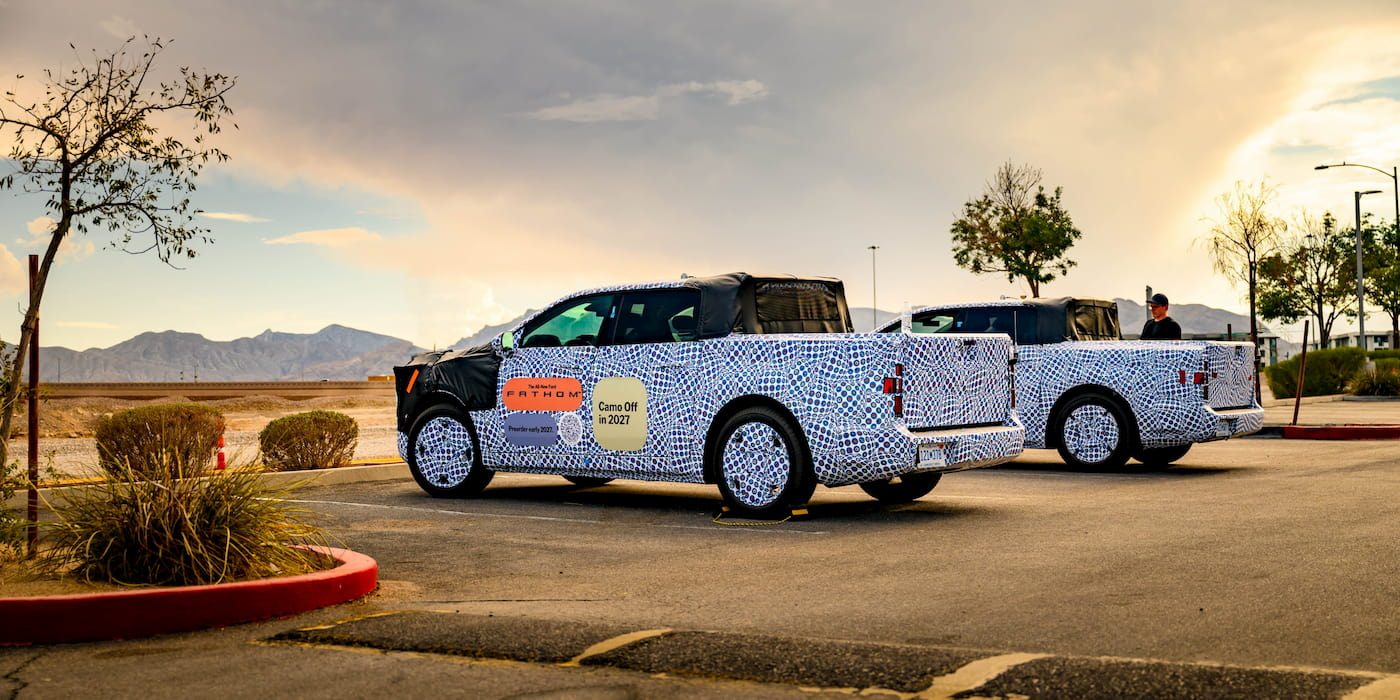
Ford has spent the past few years learning an expensive lesson about electric pickups: building a brilliant one is not the same as building an affordable one. The F-150 Lightning arrived to genuine acclaim and then ran into a wall of cost, demand and production reality. So for its next electric truck, Ford is trying something rather different. It is chasing cheap.
The Fathom, a midsize four-door electric pickup, is now the subject of a “preorder invite” sign-up list. That is not the same as a preorder. Official reservations do not open until early 2027, with deliveries beginning in late 2027, and a full reveal expected before the end of 2026. Ford has been careful not to move the goalposts on timing. A spokesperson told Electrek: “We’ve said previously, ‘Fathom will launch in 2027’ – and there is no change to that.”
The price is the headline
Everything about the Fathom flows from one number. In the US, the standard range model starts at $28,350, and even with the $1,595 destination fee it stays under $30,000. Car and Driver quotes a starting figure of $29,945, which appears to fold the destination charge into the sticker rather than list it separately, so the two numbers describe the same truck. Either way, it lands at roughly half the price of an F-150 Lightning, which is a remarkable thing to write about two electric pickups from the same company.
Ford is not just pitching a low sticker. It claims the Fathom will cost less to own over five years than a three-year-old used Tesla Model Y, which is a pointed comparison. A used Model Y is the default answer for a lot of buyers who want an electric car without paying new-car money, so Ford is effectively arguing that a new truck with a warranty beats a secondhand crossover on total outlay. That is a bold claim, and one we will want to see the workings for.
A new platform, and a cheaper kind of battery
The Fathom is the first model built on Ford’s Universal Electric Vehicle platform, a clean-sheet architecture rather than a reworked combustion chassis. It runs a 400-volt system rather than the 800-volt setups some rivals use, and it relies on lithium iron phosphate batteries that are both cobalt-free and nickel-free. Dropping those materials is the single biggest lever on cost, and Ford is pulling it hard.
The pack also does structural duty, serving as the vehicle’s floor. Ford says this lowers the centre of gravity, which improves handling and frees up interior space while making the cabin quieter. The company’s line is that the pack cuts both cost and vehicle weight, though LFP chemistry is heavier per kilowatt-hour than nickel-based cells, so that second claim is the one to watch. A standard range and an extended range pack are both expected, though neither has been confirmed.
Size, space and a slightly awkward label
Ford calls the Fathom a midsize four-door pickup. Prototypes spotted testing look closer to Maverick-sized, and the Maverick is generally filed as a compact truck. So there is a bit of a gap between the marketing language and what the camouflage suggests.
What Ford is happy to talk about is passenger space. The company claims more room for people than a Toyota RAV4, and that figure excludes both the frunk and the bed. That is a meaningful claim for a family buyer, because it means the cabin is not being compromised to accommodate the load bay. The low-slung battery pack helps here too, creating a flat floor and a more spacious feel than a traditional body-on-frame truck.
Tech that is standard rather than optional
This is where the Fathom diverges most sharply from the idea of a cheap truck. Ford is fitting a large touchscreen display and making the Fathom the first Ford with Apple Maps integrated directly into the navigation system. Digital Key, remote control through the Ford app, Apple CarPlay and Android Auto are all standard.
Every Fathom is BlueCruise-capable for hands-free highway driving, though activation costs extra and is expected to be subscription-based. The truck also supports bidirectional charging, so it can run plug-in tools or camping gear from the pack. That capability sits in the same family as the technology covered in our piece on how Tesla Powershare Home Backup Comes to Model 3 and Model Y: What You Need to Know, where an EV stops being just a car and starts being a power source. Ford has not promised full home backup on the Fathom, but the hardware direction is clear.
Ford wants it to be quick, not just cheap
Cheap does not mean slow, apparently. Ford is targeting a 0-60 mph time as quick as a four-cylinder Mustang EcoBoost, which puts the Fathom in genuinely brisk territory for a pickup. The company promises instant torque, “obsessive chassis engineering” and more downforce than you would expect from something with a load bed.
Early images of the UEV platform show a rear-wheel-drive layout, and an all-wheel-drive option is anticipated. Test mules have been spotted at a Tesla Supercharger, which points to an NACS charge port. That is a sensible choice given the state of the charging network, and it is the same practical thinking behind features like Tesla’s Emergency Drive Away Lets You Unplug by Driving Off – Even If It Wrecks the Charger, where the priority is getting the driver moving rather than protecting the hardware.
What Ford still will not tell us
The list of unknowns is long. Range, towing capability, horsepower, torque, payload rating, charging speeds, trim levels and interior measurements are all unconfirmed. For a truck, towing and payload matter enormously, and their absence from the conversation at this stage is notable.
There is also the question of how the extended range pack affects the price. The sub-$30,000 figure applies to the standard range model, and Ford has not said what the step up costs. Buyers who need to tow or cover long distances will not be shopping in the entry tier.
Louisville, and a very large ask
Production is slated for Ford’s Louisville Assembly Plant, a 3-million-square-foot facility where the first prototypes are due off the line in 2027. Scaling a brand-new platform, with a new battery chemistry, in a new architecture, at a price point nobody else has hit, is not a small undertaking.
CEO Jim Farley knows it. He has said: “It’s going to be a heck of an effort to launch this at scale, at cost, on time.” That is about as candid as a chief executive gets about a product he is about to stake a division on.
A small segment with one obvious rival
The compact electric truck segment is still tiny, which is both the opportunity and the risk. The closest comparison on price and footprint is the Slate pickup, a deliberately stripped-back machine that keeps costs down by keeping features out. The Fathom takes the opposite approach: a long standard equipment list, BlueCruise capability across the range, a large screen and Apple Maps built in.
That contrast is the whole bet. Ford is wagering that buyers want a cheap electric truck that does not feel cheap, and that the company can build it profitably at volume in Louisville. Farley has already told us how hard that will be. The run-up to reservations in early 2027 will show whether Ford can actually do it.
For more on this, see xpeng 500 000 car.




One Comment