
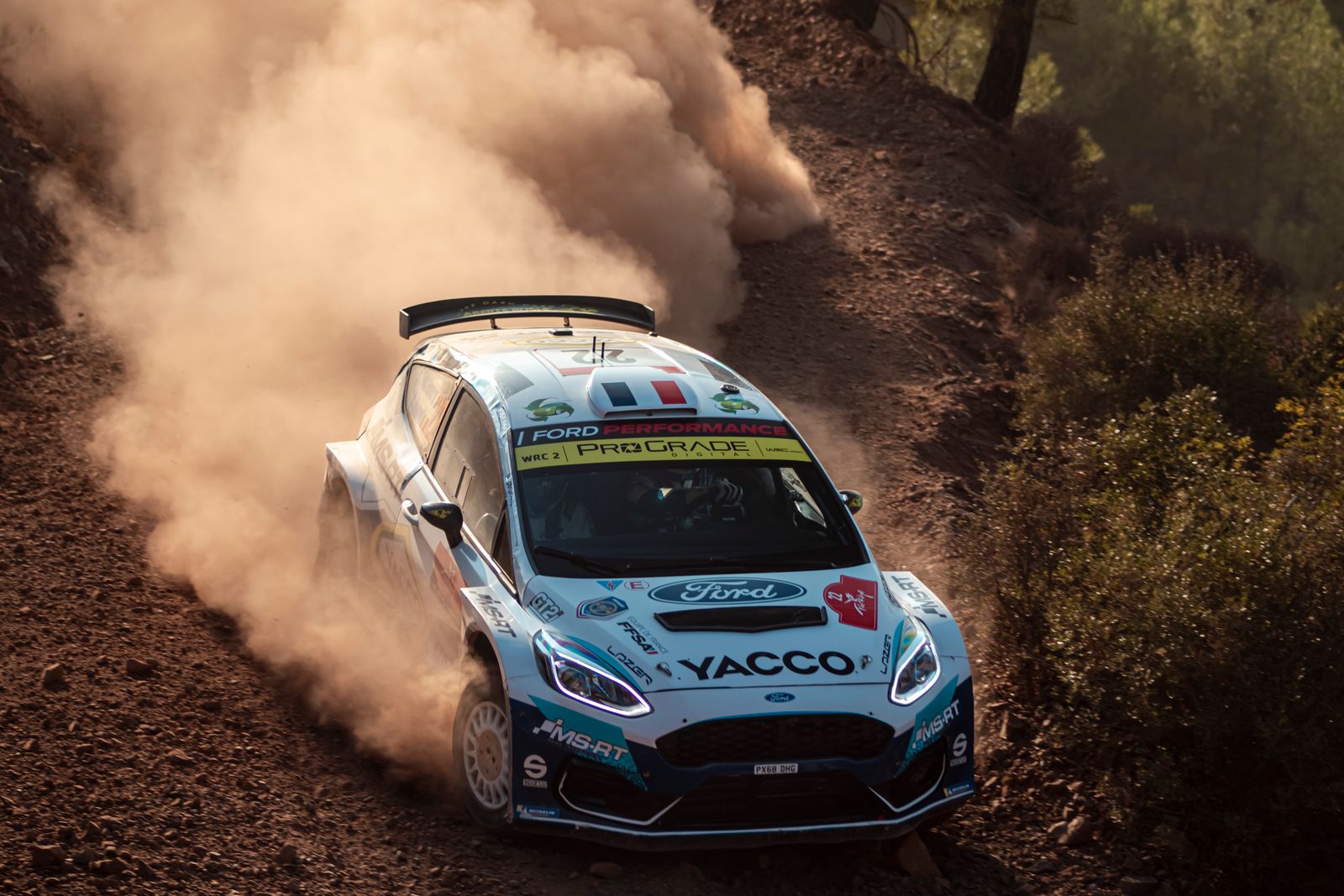
Ford’s WRC comeback: what has actually been confirmed
The headline facts are straightforward. Ford will return as a full factory manufacturer in 2028, with M-Sport running the team under the Ford Racing name. Ford will then commit to building an all-new car to contest the 2029 season, designed to the new technical regulations that come into force in 2027.
That structure matters. M-Sport has effectively been Ford’s rally operation for decades, but the distinction between a semi-works effort and a full factory programme is a meaningful one, covering funding, development resource and strategic priority. Ford is signalling that rallying sits at the centre of its motorsport plans rather than at the margins.
How the timeline unfolds
The transition is staged rather than immediate. Direct Ford support begins in 2027, giving M-Sport a year of closer integration before full factory status kicks in for 2028.
The car sequence runs as follows. The current Puma Rally1 will be dropped at the end of the 2026 season. For 2027, M-Sport will campaign an upgraded Ford Fiesta Rally2, having already committed to developing an update kit for the car so it can compete alongside the all-new Rally1-spec machinery built to the 2027 regulations. That same upgraded Fiesta Rally2 carries the team through the 2028 season, Ford’s first as a full factory manufacturer. The all-new car, built by Ford to the new rules, then arrives for 2029.
That is a notable shift in itself. The Puma gave Ford a distinctive, road-car-linked silhouette in the top category, but the move back to Fiesta branding for the interim period points towards a more traditional rallying identity while the all-new 2029 machine takes shape. The 2029 car is the real prize: the first genuinely Ford-developed top-tier rally car in well over a decade.
The people behind the announcement
Mark Rushbrook, global director of Ford Racing, framed the decision in terms of heritage. “As we celebrate 125 years of Ford Racing, our 50-year legacy in the WRC stands out as one of our proudest because of its direct connection to the fun and exciting cars that came from that,” he said. “We can’t wait to compete again in rally racing in 2028 and beyond.”
WRC Promoter CEO Eric Boullier was equally direct about what a factory Ford commitment means for the series. “Ford’s decision to return to the FIA World Rally Championship as a full factory team is fantastic news,” he said, adding that the “renewed commitment to WRC, as part of its extensive global motorsport programme, is a strong statement about the relevance of rallying to one of the world’s leading automotive brands.”
FIA president Mohammed Ben Sulayem placed the news in the context of a championship rebuilding its foundations. “With a new promoter in place, three constructors already committed to the new technical regulations, and now Ford confirming its return as a full works manufacturer, there is real momentum behind the championship’s next era,” he said.
That reference to three constructors is significant. Ford will not be returning to a comfortable field. Toyota has already committed to the WRC’s new technical rules, and the competitive benchmark in modern rallying is set by exactly the kind of manufacturer Ford now intends to beat.
A 50-year rally legacy
Ford’s factory WRC involvement traces back to the 1970s, with a first manufacturers’ crown claimed in 1979. That early success established rallying as a core part of Ford’s performance identity, and it is a thread that has run through the Escort, the Sierra and the Focus ever since.
M-Sport began operating Ford’s official WRC programme in 1997 and delivered two manufacturers’ titles in 2006 and 2007. But Ford withdrew full factory support at the end of 2012, leaving M-Sport to continue running Ford machinery as a semi-works operation with limited manufacturer backing. That arrangement has produced remarkable results given the resources available, but it has never been the same as a full works programme.
The 2028 return reverses that 2012 decision entirely. It also means M-Sport, which additionally operates Ford’s factory rally-raid programme, moves back into the position it held for the best part of two decades: running a genuine manufacturer assault on the world championship.
Rallying within a much wider motorsport push
Ford’s WRC return is not happening in isolation. The company returned to Formula 1 in 2026 as Red Bull’s engine partner, competes in the FIA World Rally-Raid Championship including the Dakar Rally, and will return to the top Hypercar class of the FIA World Endurance Championship in 2027. Add programmes in NASCAR and the Australian Supercars Championship, plus GT3 racing with the Mustang, and the scale of the commitment becomes clear.
According to Ben Sulayem, this gives Ford a presence across four FIA World Championships. That is a portfolio approach rather than a scattergun one, and it places rallying alongside Formula 1 and endurance racing as a strategic priority rather than a heritage exercise.
What it means for road cars
The most commercially interesting part of the announcement concerns the link between the rally car and the showroom. Ford claims its new-for-2029 WRC racer will be “derived directly” from its new European portfolio of “rally-bred” passenger vehicles, which the company says are intended to “help turn everyday commutes into drives worth looking forward to.”
That aligns with Ford of Europe’s plans to launch five “rally-bred” models in the coming years, as the company works to rebuild market share on the continent. The logic is familiar: motorsport success lends credibility to road cars, and a rally-bred badge carries a particular kind of weight in European markets where the discipline still resonates strongly.
The key word in Ford’s language is “directly.” This is not a marketing association bolted onto an unrelated racing programme. Ford is describing a development relationship in which the competition car and the road car line-up share engineering DNA. Whether that holds true through to 2029 will only become clear when the car and the road models it is said to be derived from are actually revealed. For now it remains Ford’s stated intention rather than a verified engineering fact.
What is still unknown
Plenty remains to be confirmed. No drivers have been announced for Ford’s 2028 or 2029 WRC campaigns, which leaves one of the more attractive seats in world rallying officially vacant for now. Given the timeline, driver announcements are unlikely to arrive soon.
There are also no details of what the new car will look like. Ford has confirmed it will be built to the 2027 regulations and derived from the new road car line-up, but nothing on silhouette, naming or technical specification has been released.
What is clear is the direction of travel. Ford has committed to a staged return, a full factory programme and an all-new car, backed by a motorsport portfolio spanning four FIA World Championships. From 2029, the question becomes whether Ford can convert that heritage into silverware.
Related: wrc united states rally.



One Comment