
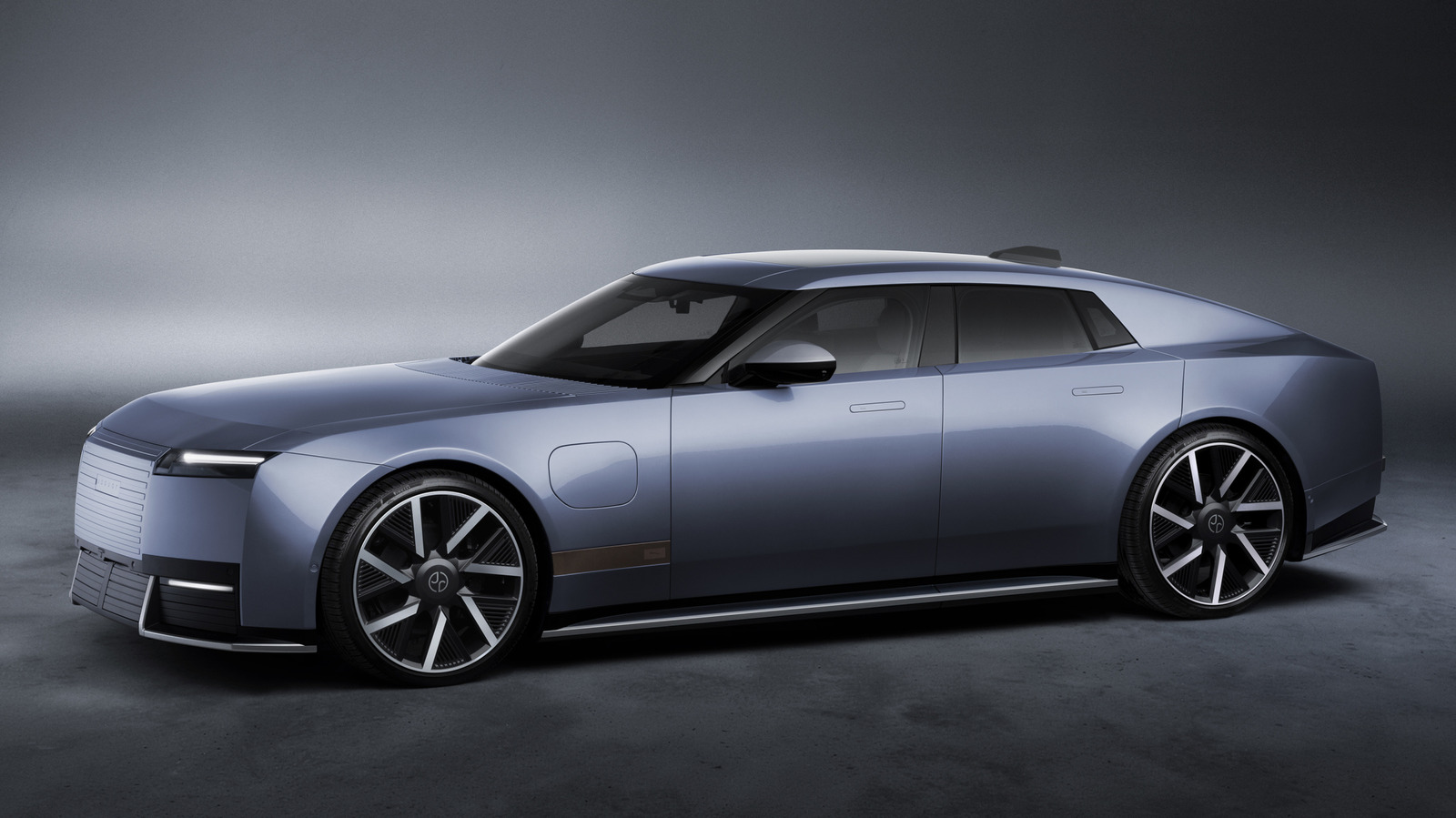
Jaguar has spent the past few years telling anyone who would listen that it was about to do something drastic. On a Tuesday evening in New York City, it finally showed its hand. The Jaguar Type 01 is a production-ready electric luxury sedan with up to 1,015bhp, a range of up to 400 miles and a shape that abandons almost every convention the marque has traded on since the 1960s. It goes on sale in the US next year, with first deliveries expected in 2027, and there is no second act waiting behind it.
A name, and a statement of intent
It is pronounced “Type Zero One,” not “Type Oh One,” and the distinction matters more than it sounds. This is the car Jaguar has staked its reinvention on, the production version of the Type 00 concept shown roughly two years ago. Design chief Andrew Wheel is blunt about what it represents, calling it “the truest expression of Jaguar, in the context of today.” That phrase does a lot of work. It acknowledges that the old Jaguar is gone while insisting something recognisable has survived the transition.
Jaguar Type 01 power, range and aerodynamic detail
The headline numbers are striking enough: up to 1,015bhp and up to 400 miles of range. Less obvious is how much effort went into making the car slippery. Jaguar quotes a drag coefficient of 0.23 cD, a figure honed over more than 7,000 wind tunnel tests. A three-stage spoiler deploys automatically, shifting between reducing drag and generating downforce depending on what the car is doing. At motorway speeds the body drops by more than 13mm, tucking the car into the airflow. It is the kind of detail that separates a design study from something engineers actually had to sign off.
Proportions borrowed from the E-Type
Jaguar quotes an overall length of 5,283mm, while Road & Track cites 5,235mm. Either way, the Type 01 is roughly 229mm longer and 25mm lower than a Porsche Panamera, at 1,397mm tall. The figure Jaguar is proudest of, though, is the dash-to-axle ratio: 889mm, or 17% of the car’s length, the same proportion as the E-Type. Twenty-one-inch wheels are standard, with 23-inch rims available, matching the concept. The stance is long-nosed, low-roofed and deliberately nothing like a conventional electric saloon, where a flat floor and a big battery usually push designers towards a tall, one-box silhouette.
Headlights, strakes and a grille that isn’t there
Up front, Jaguar has fitted the thinnest headlights in its history: 17,000 pixels, with cornering and projection technology, crammed into just 84mm of height. Wheel explains the thinking. “They’re high, to give it a proud, confident look to the front of the car, and then they go right to the edges to emphasise the width,” he says. There is no grille. In its place sits a ribbed panel carrying the new Jaguar wordmark, with active cooling vanes tucked into the angular lower bumper. The concept’s hood strakes survive at the base of the windshield and continue onto the top of the dashboard, tying the exterior to the cabin.
At the rear, more than a dozen strakes form what Jaguar calls “a key visual graphic” for the brand, with full-width taillights hidden between them and illuminating only when needed. The company says the arrangement went through 4,000 hours of engineering development. It is an unusual amount of effort for a lighting signature, and a fair indication of how much of this car’s identity rests on surfaces doing two jobs at once.
The Impossible Panel and the missing rear window
The most technically demanding element is the body panel that forms the roof sides, C-pillar and rear quarter in one piece. Jaguar calls it the Impossible Panel. Stamping it requires a six-step cold forming process and 2,500 tons of pressure from a machine four storeys high. The company’s own statement is unusually combative: “Established industry wisdom dictates no more than three planes with sweeping curves and no acute angles on a single body panel, but Type 01 shatters these constraints.” There is no rear window at all. Rearward visibility comes from a camera mounted in the roof shark fin, and the glass roof is exposed rather than disguised, providing contrast against the painted surfaces. It is a design decision that will divide opinion until the car is seen in motion, which is precisely the point Jaguar keeps making.
A restrained palette, plus 60 loud ones
Most Type 01s will be painted in what amounts to a sober greyscale: white, silver, grey, black, two shades of greyish-blue and a muted brown Jaguar calls Mermerizing Copper. As of the reveal there is no British Racing Green, no navy, no lighter blues and nothing whimsical such as orange or violet. Buyers wanting something louder will need the Chromatic Moments limited edition: 60 units finished in satin French Ultramarine or London Red. For a brand trading on emotional appeal, the standard palette is a notably restrained choice. Whether that reads as confidence or caution is one of the open questions.
A compact cabin and mixed verdicts on space
The interior is small. Describing the Type 01 as a four-door 2+2 “isn’t far off,” and the front passenger seat has slightly less legroom than the driver’s side. Journalists of different heights reached different conclusions at the static preview. One measuring 5ft 9in found ample knee room in the rear behind his own driving position; another at 6ft 3in reported both front and rear were tight. Packaging a low, long-nosed electric saloon was never going to be straightforward, and the Type 01 has clearly prioritised proportion over outright space. That trade-off puts it in direct competition with established luxury saloons rather than the more spacious electric alternatives now arriving across the market.
The Fender Ingot and the Leaper’s last stand
One detail carries more weight than its size suggests. The Fender Ingot is a piece of trim that stretches the dash-to-axle distance visually, and it is the only place on the entire car where the old Leaper emblem appears. Everything else wears the new wordmark. The Leaper’s survival in a single, carefully placed location reads as a deliberate farewell, or perhaps a placeholder for a heritage that Jaguar is not quite ready to abandon entirely. Jaguar is not the first marque to gamble its identity on a single shape, and it will not be the last.
Pricing, availability, and the judgement still to come
The Type 01 goes on sale in the US next year, starting at just over $130,000. Final judgement on the design has been deferred until a moving preview, following a static showing at Jaguar’s Gaydon headquarters. Jaguar cited co-founder William Lyons at the briefing: “to understand the design of any vehicle, you have to see it moving.” It is a convenient line for a car that has attracted plenty of static criticism, but it is also true. Road & Track compared the moment to the XJ-S’s 1975 launch, quoting its own October 1975 issue describing that car as “a surprising break from tradition” and “an XJ-12 with a new body of decidedly questionable style.” The XJ-S went on to sell for two decades. Whether the Type 01 earns a similar reprieve depends on something no press release can settle: how it looks and feels at speed, on a real road, with 1,015bhp available and nowhere to hide. Until then, Jaguar has made its bet, and the industry is watching to see whether a 2,500-ton press and a missing rear window add up to a future or a footnote.
For more on this, see jaguar type lotus britain.
For more on this, see jaguar type 120 000.






One Comment