Production Confirmed, Details Withheld
The Scrambler SRT wears a concept label, but according to The Drive it is confirmed for production and will be one of the headline models in Stellantis’ turnaround plan, which calls for 60 new vehicles and 50 refreshes by 2030. Tim Kuniskis, head of American Brands, SRT Performance and Direct Connections at Stellantis North America, presented the vehicle at SEMA. The Drive was given an early preview back in May, with photographs embargoed until now.
What Jeep has not confirmed is when it arrives or what it will cost. The Drive expects a US price above $65,000 and an arrival before 2030.
The reveal fits a pattern at this year’s show, where manufacturers used Las Vegas as a stage for machines that stretch their core identities. The Nissan Frontier Ronin concept follows a similar logic, taking a familiar nameplate somewhere unexpected. Jeep’s version of that idea is arguably bolder, because the Wrangler is one of the most sacred shapes in off-roading.
HEMI V8 and a Wrangler First: Independent Front Suspension
Under the bonnet sits a 6.4-litre naturally aspirated HEMI V8 producing 470bhp and 470lb-ft of torque. The Drive reports that no Hellcat engine is offered “right now,” so the Scrambler launches with the proven 392 rather than the supercharged flagship.
The bigger engineering story is the chassis. This is the first Wrangler with independent front suspension, developed in partnership with off-road racer Casey Currie. Jeep claims the setup improves high-speed stability, steering precision and wheel control. Suspension travel is quoted at 14 inches at the front and 15 inches at the rear, with Fox 2.5-inch shocks at all four corners.
The IFS did not appear from nowhere. Jeep first showed the concept on the Striker Concept in March, then validated it in Currie’s custom Gladiator “Striker,” which took a class victory at the NORRA 500. That is a useful reminder that this is not a styling exercise with a V8 dropped in. The hardware has been raced.
Built for Whoops, Not Boulders
The rear end is where the Scrambler departs most sharply from Wrangler orthodoxy. It uses a trophy-truck-style rear axle and suspension designed for high-speed impacts rather than rock articulation, the kind of setup that soaks up repeated hits across desert terrain instead of slowly flexing over an obstacle.
Kuniskis was blunt about the brief. “This is mission specific,” he said. “This will go through high-speed desert whoops better than any solid axle ever could.”
He also framed the project as a challenge to Jeep’s own instincts, describing it as “a dare” to the brand’s playbook. That is a striking admission from a company whose marketing has leaned on rock-crawling imagery for generations. The Scrambler SRT is explicitly not for the trail-riding crowd. It is for the buyer who wants to run a desert road at speed and land the other side.
Sharknose Styling and 37-Inch Rubber
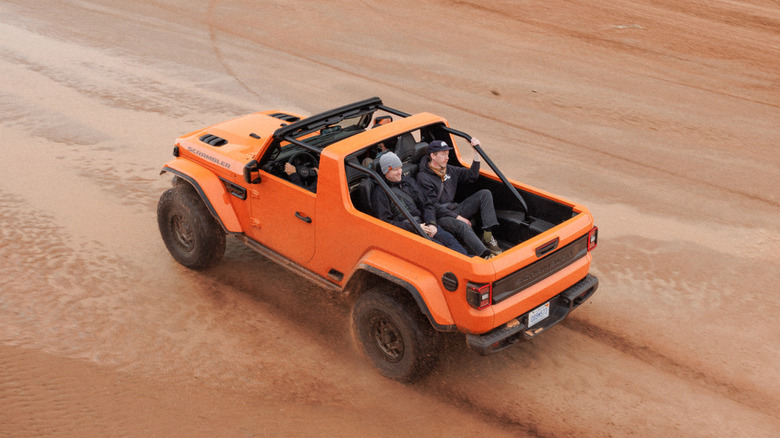
The body is a two-door, far shorter than a Gladiator, with a front end inspired by the early-1980s CJ-8 Scrambler. The sharknose design and heavily flared fenders give it a planted, aggressive stance, and the whole thing is finished in Punk’n orange.
It rides on 37-inch BFGoodrich off-road mud-terrain tyres wrapped around beadlock wheels. Jalopnik drew a comparison with the 2018 Jeep Sandstorm Concept, though the two are different vehicles built to different briefs.
Jump Seats and a Removable Back Cap
The bed is the cleverest part. It features 180-degree reversible, removable jump seats that clip into floor-mounted hooks, so occupants can face forward or rearward. That layout echoes desert chase trucks and spotters, and it is a neat piece of problem-solving rather than decoration.
“You can then fold that seat backwards flat and it makes a bed floor like a truck,” Kuniskis said.
The rear back cap, a camper-style shell, can be removed in the manner of an old K5 Blazer. With the cap off and the seats in the normal front-seat position, Kuniskis said the interior “almost seems like you’re in a four-door Wrangler.” He described the Scrambler as “a Swiss Army Knife” of trucks, and “freaking cool.” The enthusiasm is genuine, and it is hard to argue with the logic of a vehicle that changes shape to suit the job.
What It Means for the Wrangler
The Scrambler SRT raises an obvious question about the standard Wrangler. Ford already fits independent front suspension to the Bronco, and Jalopnik speculates that the Wrangler may adopt it in future. If Jeep is validating IFS in competition and putting it into a production-bound halo model, the case for wider adoption builds with every mile.
Production location is not confirmed, but the Wrangler chassis means the Toledo Assembly Complex in Ohio, which already builds the Wrangler and Gladiator, is the natural home. On price, the Scrambler sits well above the Bronco’s performance variants. The 2027 Ford Bronco RTR starts at just over $50,000 before destination in the US, with a loaded example at just under $60,000. A $65,000-plus Jeep would sit clearly above that, which tells you how Jeep is positioning the Scrambler: not as a rival to a fast Bronco, but as something closer to a road-legal trophy truck.
The SEMA floor is full of builds that never make it. Toyota’s Crown Signia GT-S concept is a good example of a show car that exists mainly to gauge reaction. The Scrambler is different, because Jeep has already committed to building it.
A Halo Model That Redraws the Wrangler’s Boundaries
The Wrangler Scrambler SRT is the most interesting thing Jeep has done with its signature model in years, and not because of the V8. Plenty of Wranglers have had eight cylinders. What matters is the independent front suspension, the trophy-truck rear end and the admission that a Wrangler can be built for something other than crawling. If the Wrangler can go fast across a desert, the next generation can plausibly adopt more of this hardware.
The Scrambler will not suit everyone, and at a likely $65,000-plus in the US it is not meant to. But it opens a door. For now, buyers get a two-door, V8, IFS desert truck with removable seats and a roof section that comes off like a vintage Blazer. That is a strange, specific and rather brilliant combination, and it is coming to showrooms.