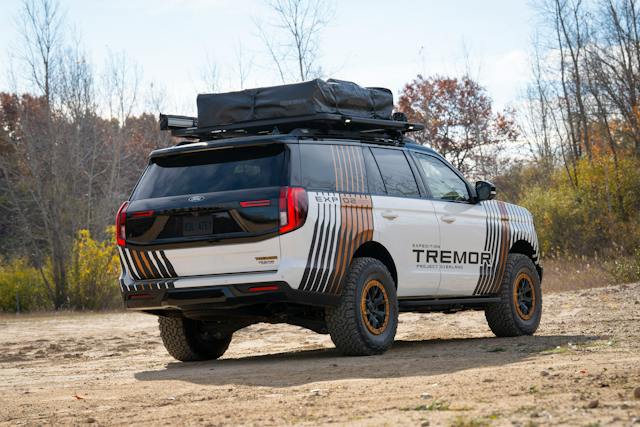
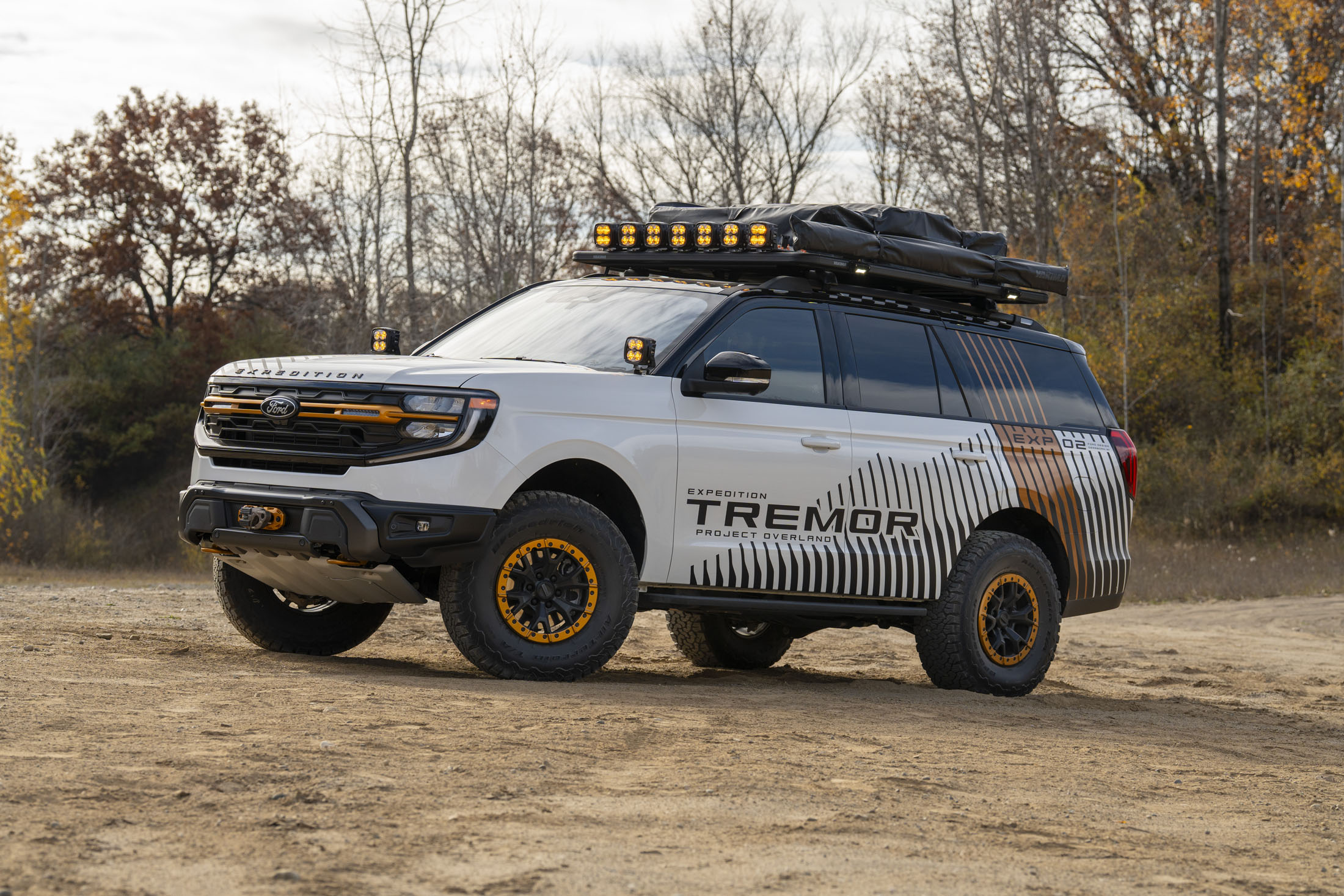
Ford has a long history of building concepts that never reach a showroom, and the Blue Oval’s latest off-road creation follows that tradition to the letter. The Expedition Tremor Project Overland is a one-off overlanding build based on the 2025 Expedition Tremor, developed in collaboration with Fox Factory Vehicles and revealed at the Los Angeles Auto Show. Ford has no plans to sell it in this form. Instead, it serves as a test bed for figuring out exactly what buyers want from a purpose-built full-size off-road SUV.
What Project Overland actually is
Start with the base. The Expedition Tremor is already the most capable version of Ford’s full-size SUV, offering up to 10.6 inches (269mm) of ground clearance as standard. Project Overland takes that foundation and pushes it further into overlanding territory, the slower, load-carrying, self-sufficient end of off-roading rather than the high-speed desert running that tends to dominate marketing material.
The collaboration with Fox Factory Vehicles is significant. Fox supplies suspension for Ford’s current Raptor models, so the relationship is well established. Ford’s own parts department also had a hand in the project, which explains why so many of the components look like things you could actually order.
The hardware: lift, wheels and tyres
The most obvious change is a 2-inch (51mm) lift kit built around FOX 2.0 Performance Series coilovers. That is a modest increase by the standards of some builds, but it is enough to clear the sort of terrain overlanders actually encounter without ruining road manners entirely.
The wheels are a neat piece of parts-bin engineering: 17-inch items sourced from the F-150 Raptor R, wrapped in 35-inch BFGoodrich KO2 all-terrain tyres. Using Raptor R wheels on an Expedition is exactly the kind of pragmatic decision that makes a concept feel plausible as a production package. Nothing here requires a bespoke supply chain.
Armour, recovery gear and a clever cooling fix
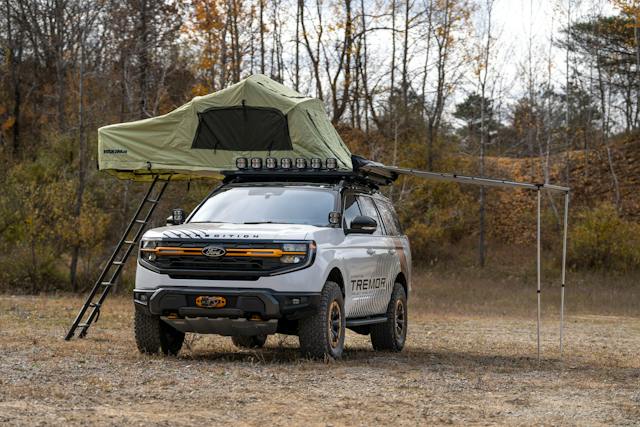
Up front, the build uses a modified modular F-150 Tremor bumper housing a hidden Warn winch. That hidden installation keeps the front end looking relatively clean, but it creates a genuine engineering problem: a winch sitting in the bumper restricts airflow to the intercooler. Ford’s solution was to fit an upgraded intercooler to offset the restriction. It is a small detail that reveals the build was engineered rather than simply assembled, and it is the sort of thing that separates a credible concept from a show stand ornament.
Lighting, camp kit and the overlanding essentials
Lighting comes courtesy of RIGID Phoenix ditch lights mounted at the base of the A-pillars, plus a roof light rack and Rigid DC scene lights for setting up camp after dark.
The camping hardware is where Project Overland leans hardest into its overlanding brief. There is a Yakima Skyrise HD softshell rooftop tent, an OverNOut side awning, Tred Pro recovery boards and Ford liftgate side curtains. None of it is exotic. Most of it is available from the respective suppliers, which is rather the point.
Cabin tech borrowed from the F-150 Tremor
Inside, the concept adopts the overhead console from the F-150 Tremor, complete with prewired upfitter switches. These allow accessories such as the ditch lights and the winch to be controlled without a tangle of aftermarket wiring. There are also wireless controls for accessories, which is the kind of feature that sounds trivial until you have spent an evening routing cables through a firewall.
For anyone who has built an overlanding vehicle themselves, the appeal is obvious. Factory-integrated switching is cleaner, safer and far easier to live with than the usual rat’s nest of relays and inline fuses.
Why Ford built a truck it won’t sell
Ford’s messaging is refreshingly honest. The company describes Project Overland as an idea generator for future collaboration with Fox Factory Vehicles, and says a more serious Expedition variant could reach production if there is enough interest. The fact that most individual parts can be bought from their respective suppliers suggests Ford is testing whether a factory-backed package would find buyers. It is a lower-risk way of exploring a niche than committing to a full production programme.
The concept-car landscape is full of machines that exist purely to provoke a reaction. A recent example is the Nissan Frontier Ronin Concept: GT-R Twin-Turbo Desert Runner Revealed for SEMA, a build that answers to no particular rulebook. Project Overland sits at the opposite end of that spectrum: restrained, practical and almost entirely achievable with off-the-shelf parts.
The speculation, clearly flagged
Hagerty, which reported on the build, floated a few possibilities that Ford has not confirmed. One is a production options package sitting above Tremor in the Expedition hierarchy. Another is splitting the Expedition line into separate off-road disciplines, with Tremor leaning toward higher-speed ability and a second variant aimed at slower overlanding. The obvious comparison is Toyota’s approach with the Sequoia, where TRD Pro and Trailhunter variants serve different purposes.
There is also a more distant possibility that Ford and Fox are exploring an early-stage new model for the Raptor family, given Fox’s existing suspension supply relationship with current Raptors. That remains speculation. Ford has said nothing to confirm it.
Market context
The commercial logic is not hard to follow. Ford told Car and Driver that nearly 25 percent of its US sales are off-road models. That is a substantial chunk of business, and it explains why the company keeps investing in Tremor, Raptor and Bronco derivatives.
The Expedition itself is a full-size SUV sold in the US. No UK pricing or availability has been announced, and the model is not part of Ford’s UK line-up.
The verdict: a concept worth watching
Project Overland is not the most dramatic concept to emerge this year, and that is precisely what makes it interesting. There is no wild bodywork, no improbable powertrain swap and no promise of a production date that will quietly slip. Instead, there is a sensible lift, a well-chosen wheel and tyre package, proper recovery gear and factory-integrated switching. Every element feels like something a buyer could genuinely use.
The question now is whether enough people say so. If the reaction at the Los Angeles Auto Show is strong enough, a more capable Expedition sitting above Tremor starts to look like a straightforward business case rather than a flight of fancy.
For now, Project Overland remains a one-off. But it is the most convincing argument yet that Ford’s full-size SUV has more off-road potential than the current line-up lets on, and that the Blue Oval is paying attention to the overlanding crowd rather than leaving that market to the aftermarket.