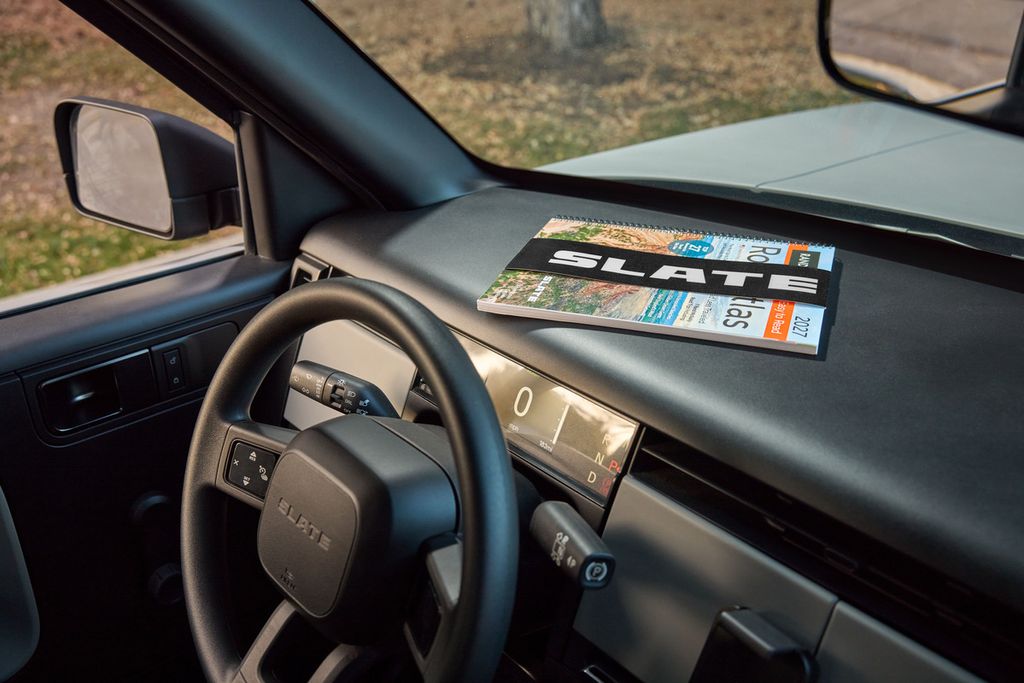
Slate Auto has found an unusual way to turn a missing feature into a marketing asset. The American EV startup is selling a paper road atlas as a “Screenless GPS,” and the joke lands because the Slate Truck genuinely does not have a central infotainment screen.
The product is a Slate-branded Rand McNally 2027 Road Atlas, priced at $30 in the US and described as a limited edition available in limited quantities through the company’s online store. Slate markets it as “the original navigation system,” with a pitch that leans hard into the absurdity: zero boot time, no subscription fees and unlimited battery life. It also concedes, cheerfully, that it offers no turn-by-turn directions.
It is a gag, but a calculated one. Behind it sits a deliberate product philosophy that treats the screen as the most overpriced and least essential part of a modern car.
What the Screenless GPS actually is
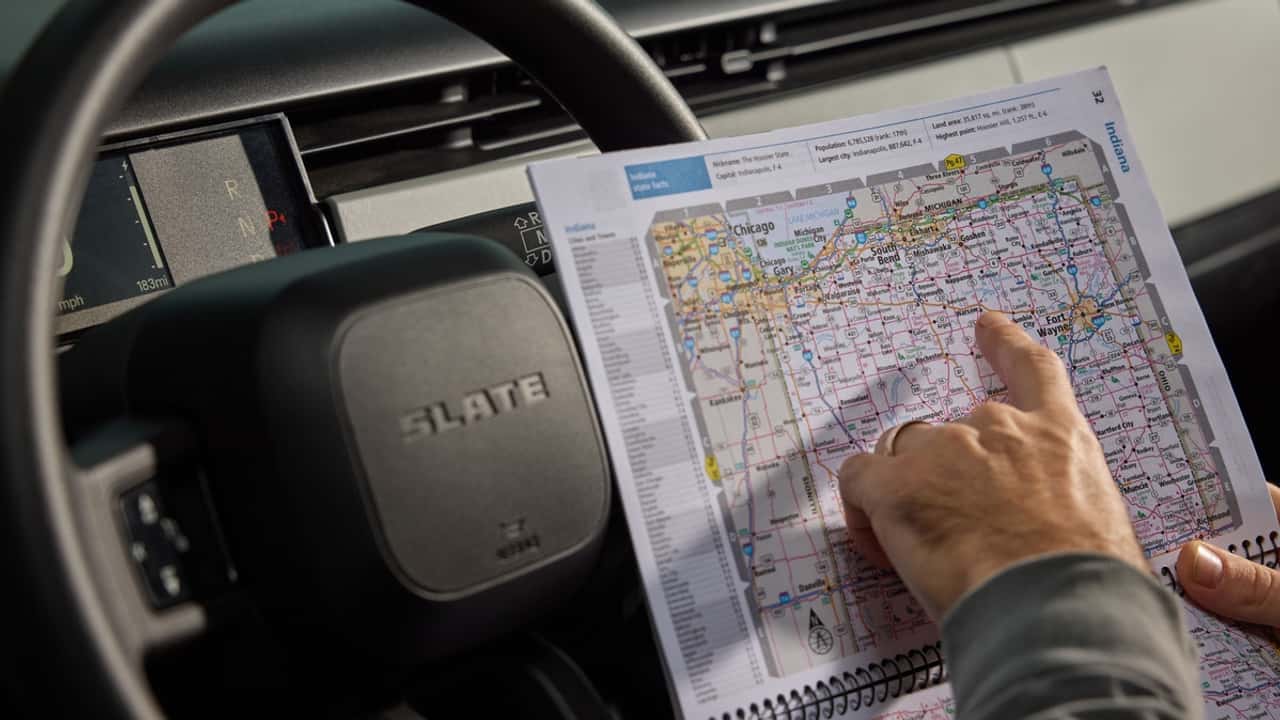
Strip away the branding and the atlas is a Rand McNally 2027 Road Atlas covering the United States, Canada and Mexico. It is a familiar object: printed on paper, and entirely useless without a sense of direction or a passenger willing to navigate.
Slate’s framing is what makes it a story. By calling a paper map a GPS, the company is poking fun at the assumption that every new vehicle needs a large glowing display running subscription services and over-the-air updates. The listed benefits read like a parody of an infotainment spec sheet, and that is precisely the point. Zero boot time is a real advantage over a system that takes 20 seconds to wake up. No subscription is a real advantage over a car that charges annually for map updates. Unlimited battery life is a joke that happens to be true.
Slate is also selling the atlas alongside optional extras that range from the analog to the digital to the mechanical, including a phone-based solution and an SUV kit that adds extra seats and a roof. The catalogue reads less like a car configurator and more like a camping shop, which appears to be exactly the tone the brand wants.
Why a paper atlas exists in 2026
The Slate Truck has no central infotainment screen at all. Navigation is expected to be handled by the owner’s phone, and a phone mount is included with the vehicle. The company’s stated rationale is refreshingly blunt: “When it comes to tech, we believe you should use the devices and solutions you already know and love. Not because we don’t like tech, but because we believe you already have everything you need to get where you’re going.”
That is a direct challenge to the way most manufacturers have spent the past decade. Screens have grown larger, more complex and more expensive, and they have become the primary interface for climate control, media and navigation. They have also become a source of frustration, with laggy software, subscription fees for features that used to be free, and touch controls that are harder to use on the move than a physical dial.
There is a serious argument buried in the joke. If a driver already carries a smartphone with better mapping, live traffic and regular updates than any built-in system, then the case for a large central display weakens considerably. Slate’s bet is that a meaningful number of buyers would rather mount the device they already own than pay for a second, inferior one.
The affordable electric pickup has become one of the industry’s favourite promises and one of its most stubborn problems, as we saw with the BMW i3 pickup conversion. Every few months another manufacturer announces a cheap battery-powered truck, and every few months the price creeps up or the launch slips back. Slate’s answer is to strip cost out of the vehicle itself, and the missing screen is one of the most visible places it has done so.
The no-frills truck behind the stunt
The atlas would be a weak joke if the vehicle did not back it up. The Slate Truck is deliberately, almost provocatively basic. It has hand-crank windows. The composite body panels are left unpainted. Carpeting is minimal. There is no central screen.
Underneath the spartan specification sits an LFP battery, with a quoted range of 205 miles per charge on the US testing cycle. The truck is offered in three customisable body styles, with US starting prices ranging from just under $25,000 to just over $32,000 (around £19,000 to £24,500 at current rates) depending on the configuration chosen.
That pricing sits in contested territory. Ford has spent the past few years learning an expensive lesson about electric pickups: building a brilliant one is not the same as building an affordable one. The F-150 Lightning arrived to genuine acclaim and then ran into a wall of cost, demand and production reality, as widely reported. The Ford Fathom electric pickup shows how quickly that segment is now filling with sub-$30,000 claims. Slate’s advantage is that its truck was designed around a low price from the start rather than engineered down to one later.
The value question
Here is where the Screenless GPS gets awkward. The same Rand McNally 2027 Road Atlas is listed at $19.99 on Amazon without Slate branding. Buyers are therefore paying roughly $10 more for a badge and the limited-edition label.
Whether that is a rip-off or a fair price for a piece of automotive merchandise depends entirely on what the buyer thinks they are purchasing. As a navigation tool, it is poor value: the unbranded version is identical inside. As a novelty item from a company that has built its identity around not taking screens too seriously, it is a reasonable souvenir. Plenty of carmakers sell branded caps and keyrings at similar mark-ups without anyone calling it a scandal.
The atlas also functions as a statement of intent. Every Slate Truck that leaves a showroom with a paper map in the glovebox reinforces the brand’s central claim: that the essentials of driving have not changed, and that the industry has spent a lot of money pretending otherwise.
US coverage has largely read the atlas as a joke. InsideEVs described the product as “tongue-in-cheek and a bit of a stunt,” while Road & Track treated it as an opinionated piece in the same spirit. Both readings are probably correct.
The more interesting question is what the stunt reveals about the market. The launch is framed as a bet that buyers are tiring of expensive, screen-heavy cars, and there is evidence for that fatigue. Software glitches, subscription creep and the cost of repairing complex displays have all become live complaints among owners. The same tension is visible at the opposite end of the market, where flagship models compete on ever more elaborate technology, as the BYD Atto 8 vs BMW iX4 comparison makes clear.
Slate is betting that a slice of the buying public wants the opposite: a simple, cheap, repairable vehicle that does not pretend to be a smartphone on wheels. The atlas is the cheapest possible way to make that argument visible, and it has already generated more column inches than most specification sheets ever will.
There is a risk. Low-tech can shade into cheap, and buyers who expect a certain level of equipment may find hand-crank windows a step too far. The truck also has to convince people that a 205-mile range and a phone mount are enough for daily life, which will not suit everyone. But as a piece of positioning, the Screenless GPS is unusually effective. It turns a cost-cutting decision into a brand statement, and it does so with a sense of humour that most car advertising lacks.
When the Slate Truck arrives
Slate plans to deliver its first trucks later this year in the United States, and the company has opened its first showroom, where the truck can be test driven.
The Screenless GPS is, for now, a US curiosity: a $30 paper map with a $19.99 twin on Amazon, sold by a startup that thinks the best navigation system is the one already in your pocket. It is a joke, a marketing exercise and a genuine product philosophy all at once, which is a difficult trick to pull off. Whether buyers agree will become clear when the first trucks reach driveways later this year.