
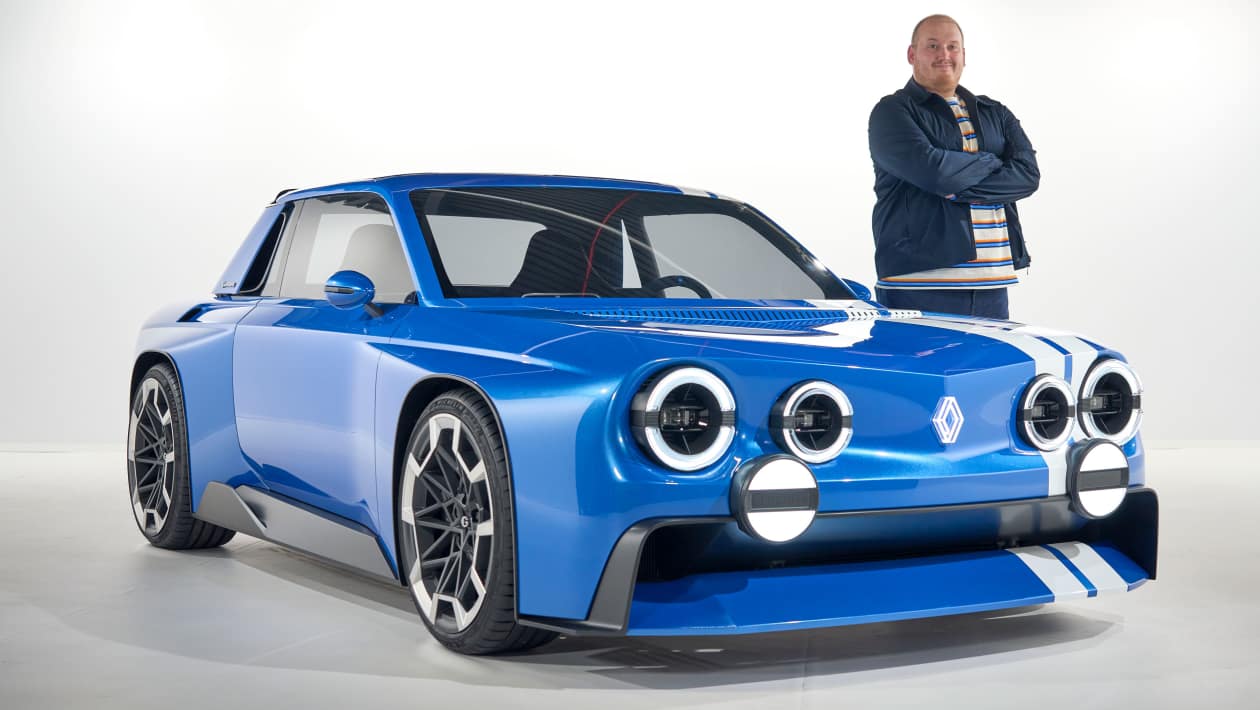
The Renault 8 Gordini Concept is back, and it has never looked quite like this. Renault has unveiled an all-electric concept that resurrects one of the most beloved badges in French motorsport history, wrapping it in a body that fuses 1960s rally aggression with a distinctly modern electric heart. It is a blank-sheet reimagining of what a small, fast, rear-driven French sedan could be in an electrified era.
It is also, by the admission of the people who built it, a bit of a “grande folie.” And that is precisely the point.
The Gordini Legacy
Before Renaultsport, before Alpine became Renault’s performance halo, there was Gordini. Amédée Gordini earned the nickname “the wizard” for his uncanny ability to extract extraordinary power from small engines, and from the late 1950s his tuned Renaults became a fixture of European motorsport. Renault-Gordini motors competed at Le Mans and in Formula 1, turning humble production cars into giant-killers on the world’s biggest stages.
The road cars carried that spirit to the public. The Renault 5 Gordini, sold in Britain through the 1980s, brought the badge to a new generation. But the most famous of them all remains the 1964 Renault 8 Gordini, a fast French saloon that became a rally legend and a cultural touchstone for an entire generation of enthusiasts. It was affordable, it was rear-driven, and it was quick enough to embarrass far more expensive machinery on a twisty road.
That combination of accessibility and mischief is exactly what Renault wanted to capture again.
Design Development: Two Months, 300 Proposals
The concept came together at remarkable speed. Renault’s design team submitted 300 proposals before settling on the final form, and the whole project went from brief to finished concept in just two months.
Romain Gauvin, head of advanced design and concept cars at Renault, was as surprised as anyone by the pace. “Usually, if I ask the team to work on some boring project, it will take a lot of time,” he said. “But this one, I don’t know why, but it went very fast.”
The reason, arguably, is that nobody involved found it boring. The team started from a blank sheet, and one of the first decisions was to abandon the original’s four-door layout in favour of a sportier two-door sedan. Gauvin framed the design intent as “grande folie,” or big craziness, and two doors simply suited a wild car better than four.
Yet the wildness is tempered by something warmer. Gauvin described the goal as keeping the car feeling “very approachable, humble, like it’s a car made for everyone.” That balance, between madness and modesty, defines the whole project.
Exterior Styling: Retro Cues, Modern Aggression
The design thesis is simple: honour the original’s silhouette, then let modern proportions do the intimidating. The silhouette is unmistakably classical. A three-box shape with an upright, boxy stance invites comparisons to the Lancia Fulvia, the BMW 2002, the Mk1 Ford Escort, and the Alfa Romeo GT 1300 Junior. It is a shape that speaks of a golden age of small European performance saloons, and Renault has leaned into that heritage rather than running from it.
The retained cues are deliberate and specific. There is the V-shaped prow, the quad-headlight arrangement, the squared-off wheelarches, and the signature double white stripe running over Bleu de France blue paint. The recessed waistline embossing of the original returns too, though it now feeds an air vent rather than simply decorating the flanks.
Where the concept departs from history is in its proportions and attitude. At 4.12 metres long, it is far stubbier than a BMW 2 Series and only slightly longer than the original R8, but it sits considerably wider and lower. Flared wheelarches, staggered 19-inch front and 20-inch rear wheels, and a raked stance give it a presence the 1964 car could never have imagined. A large, deep diffuser anchors the rear, while extra spotlights honour the car’s rally success and an F1-style rain light nods to Gordini’s motorsport pedigree.
The most striking detail sits at the back. The tail-lights are mounted beneath laser-etched, painted plexiglass, rendering them invisible when switched off and appearing, almost magically, as though projected onto the bodywork when illuminated.
Interior Craftsmanship: A Cafe Racer Cockpit
The cabin’s guiding principle is subtraction. Inside, Renault has resisted the urge to fill the cabin with screens. There is no large touchscreen. Instead, the driver faces simple round dials that echo the headlight design, set into a brushed aluminium dashboard. It is a pared-back, cafe racer-inspired space built around focus rather than features.
Stéphane Maiore, Renault’s interior design director, explained the philosophy clearly. “The entire interior and instrument cluster sit beneath a fluid, wraparound beltline, creating a sense of purity and providing the driver with a perfectly unobstructed field of vision.”
The materials list reads like a rejection of modern performance car orthodoxy. Blue corduroy covers the lower dashboard and the bucket seats. Alcantara and leather appear on the three-spoke steering wheel and elsewhere. Brushed aluminium switchgear sits on the centre console. Notably, there is no cheap plastic and no carbon fibre, a decision that keeps the cabin warm and tactile rather than cold and technical. A red stopwatch needle provides one of the few flashes of colour and theatre.
It is an interior that feels curated rather than specified, and it reinforces the idea that this is a car built for the pleasure of driving rather than the performance of owning.
Performance and Positioning: 266bhp to the Rear Wheels
Underneath, the concept is fully electric, producing 266bhp and sending it to the rear wheels. That rear-drive layout is a direct link to the 1964 original, which also put its power down through the back axle. Renault has not disclosed battery capacity, claimed range, or acceleration figures, and the concept does not sit on a confirmed production platform, which is typical for a design study at this stage.
The more interesting story is where the car sits in Renault’s broader strategy. The Gordini badge is being positioned to reinforce Renault’s fun-focused identity, sitting in deliberate contrast to Alpine, which carries the group’s more serious, focused performance mantle. Think of it as the difference between a car that makes you grin and a car that chases lap times.
That positioning matters in a market where electric performance is becoming commoditised. Rivals are chasing ever larger power figures, and Peugeot’s electric E-208 GTi shows how quickly the hot hatch segment is electrifying. Renault’s answer is not to out-muscle them, but to offer something with more character and less pretension.
Related reading: Peugeot E-208 GTi: The Electric Hot Hatch That Revives a Legend
Why the Renault 8 Gordini Concept Matters
The easy read on this concept is that it is a charming piece of nostalgia, a design study destined for a motor show stand and nothing more. That undersells it. The Renault 8 Gordini Concept is a statement about what Renault wants its electric future to feel like: playful, approachable, and unafraid to be a little bit silly.
It also demonstrates that heritage can be a creative springboard rather than a crutch. By starting from a blank sheet and refusing to simply electrify an old shape, the design team produced something that honours the past without being trapped by it. The two-door conversion, the laser-etched plexiglass, the corduroy, the absence of a touchscreen: these are choices, not obligations.
Whether a production version ever emerges is another question entirely. But as a signal of intent, the concept does its job. It reminds us that the Gordini name once stood for extracting joy from modest machinery, and it suggests that Renault has not forgotten how. In an era of increasingly homogenised electric performance, a little craziness goes a long way.
We covered renault gordini concept electric in more detail elsewhere.





4 Comments