
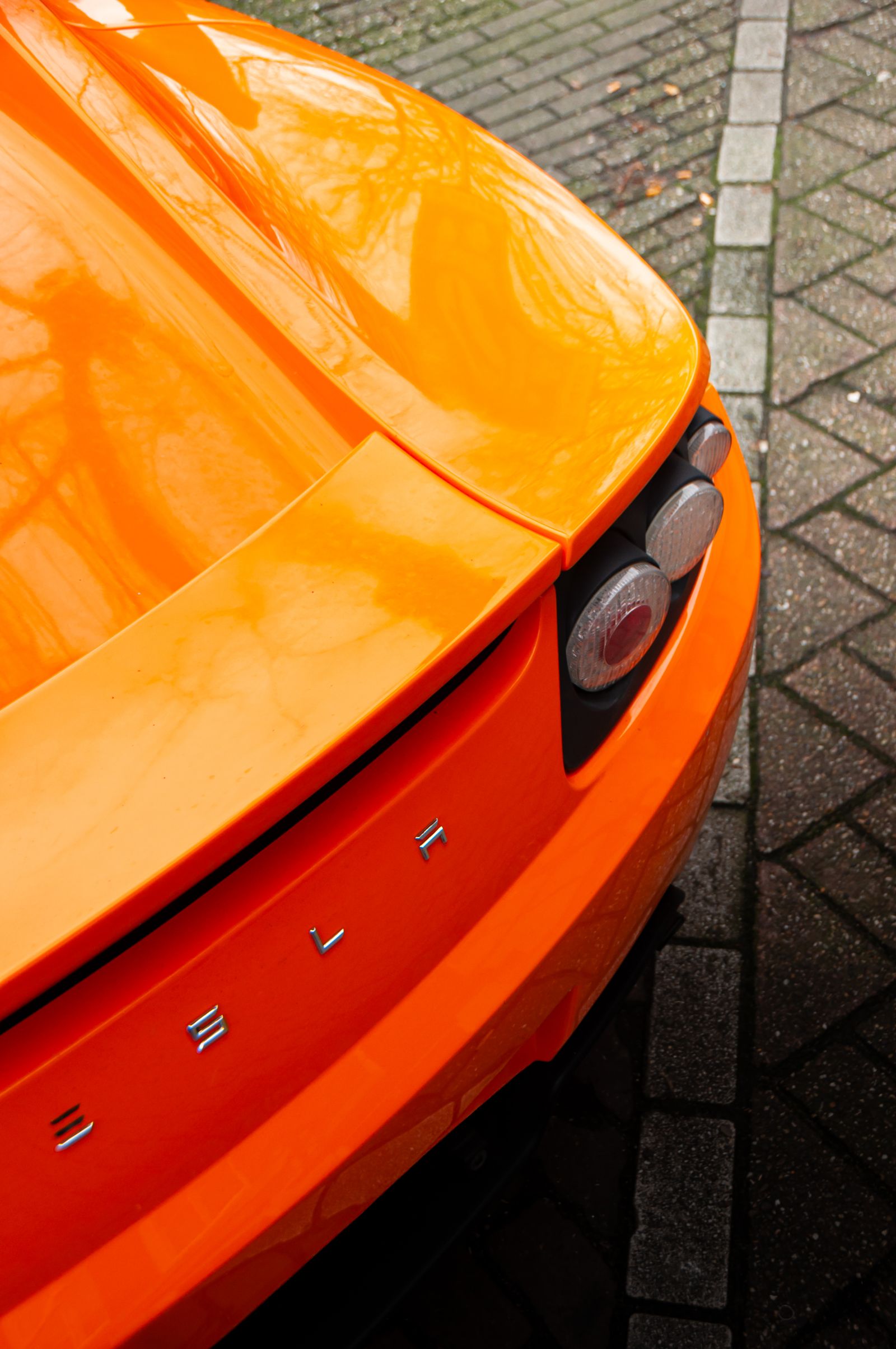
Nine years after the first prototype
The Roadster was never supposed to be a long-running mystery. When Elon Musk pulled the wraps off the concept in 2017, it felt like a bonus reveal, a bit of theatre tacked onto the end of a commercial vehicle launch. The nine-year saga that followed has turned that afterthought into one of the most drawn-out product launches in modern motoring.
What Tesla showed on 15 October 2026 is described as production-spec, a meaningful step up from a styling buck. It is also, by Musk’s own admission, commercially marginal. That tension runs through everything below: a car built to generate headlines and drag a brand’s image upward, rather than to generate revenue.
Thrusters, fans and a sub-one-second sprint
The headline claims have not been softened. Tesla says the new Roadster will use fans to suck the car onto the road, and cold-gas thrusters to jump over other cars, perform mid-air barrel rolls and hit 60mph from standstill in under a second.
Some of that is more plausible than it sounds. Downforce-generating fans are established engineering, used in racing for decades, and a cold-gas thruster is essentially a pressurised bottle and a nozzle. The physics of accelerating a car below one second to 60mph is harder, because it requires grip that no conventional tyre can deliver, which is presumably where the fans come in.
The mid-air barrel roll is a different category of claim. It is a stunt, not a feature, and it depends on a customer being willing to launch a road car off a ramp with a pressurised gas system on board. Tesla has not explained how any of this will be homologated for road use, and it has a track record of promising features that never reach production.
Tesla Roadster price: the $200,000 that has not moved (US pricing)
The money is the strangest part of the story. The 2017 prototype was priced at $200,000 in the US, with deliveries originally promised for 2020. That figure has not been updated, and US reservations remain $50,000 each. Those deposits are still held, now against a production start two years away.
Tesla has reopened the reservation book. Buyers pay a deposit to join the reservation list, as set out in this breakdown of what the $50,000 deposit actually buys.
Nine years of holding customer money against an unbuilt car is a long time even by supercar standards, where multi-year waiting lists are normal. The difference is that most low-volume manufacturers have a factory, a homologation path and a delivery schedule. Tesla has a date.
Roof, doors and where the luggage goes
The packaging raises questions Tesla has not answered. The butterfly doors cut into the roof, leaving a narrow centre section that appears to be structural, and the upper door glass may be removable, based on test mules and prototype trim. That would make the car a split-roof T-top rather than a traditional convertible, and it creates a storage problem, since the car appears to have no boot with a large air tank mounted behind the passenger compartment. Removable panels need somewhere to live when they are not on the car, and a pressurised gas bottle is an awkward thing to relocate.
Musk’s own verdict
The most revealing comment came in 2023, when Musk described the Roadster as a “small potato situation” that would not “move the needle in a major way financially.”
It is a striking thing for a chief executive to say about a flagship product, and it is worth taking at face value. Tesla does not need the Roadster to sell in volume. It needs the Roadster to exist, to remind people that Tesla is still the company that does the outrageous thing. A halo car earns its keep through what it does for the rest of the range, which is presumably why the wider electric line-up has been filling in the practical gaps while the Roadster holds the spotlight.
Why the credibility question will not go away
Tesla’s pattern is well established. Features are announced, demonstrated in prototype form, and then quietly dropped or deferred. Buyers and investors have learned to discount the more theatrical claims, which is a rational response to a decade of evidence.
None of that makes the Roadster a con. It makes it a bet, and the odds depend on how much of the 15 October presentation survives contact with regulators, suppliers and physics. A 2028 production start is two years away, which in Tesla terms is roughly three product cycles of promises. The gap between a concept and a product is where most of these claims will be settled, and Tesla has not yet shown its working.
The Roadster’s real function may be simpler than any of the technical claims suggest. It exists to keep Tesla in the conversation while rivals with more conventional product plans crowd the market around it. A car that jumps over other cars is not a business plan, but it is a statement of intent, and Tesla is still making it. Whether the Roadster ever reaches a customer driveway in the form promised is now a question about credibility rather than engineering. Nine years in, that is the only claim Tesla has left to prove.


2 Comments