Used electric cars have spent years being the awkward lot at the back of the forecourt, the ones with the depreciation curve everyone warned you about and a trade-in value that seemed to fall faster than the battery gauge on a cold morning. That story has now been turned on its head. According to a US iSeeCars study reported by Car and Driver, used EVs are now the fastest-selling cars in that market, shifting off dealer lots quicker than petrol and hybrid equivalents, and they are doing it while their prices climb. It is a remarkable reversal, and it says a lot about how far the second-hand electric car has come.
The headline finding: EVs are now the quickest cars to leave the forecourt
The iSeeCars research looked at more than 1.5 million cars aged between one and five years, comparing September 2025 with September 2026. The headline is simple enough: used EVs averaged 41.9 days on the market in September 2026, a full 13 days fewer than petrol cars, while hybrids sat at around 48.6 days. Year on year, used EVs sold 10.1% faster, whereas petrol cars actually took 19.9% longer to find a buyer.
That is not a small shift in sentiment. A car that sits on a forecourt is money tied up for the dealer, so days on market is one of the purest measures of demand there is. For years, the received wisdom was that used EVs lingered while buyers walked past them towards a petrol hatchback. The data now says the opposite, and it says it clearly.
What the numbers say
The gap between the powertrains has widened rather than narrowed. In September 2026, used EVs were turning over in under six weeks on average, roughly two weeks quicker than petrol cars and more than a week quicker than hybrids. The year-on-year comparison is even more striking: EVs sped up by around a tenth while petrol cars slowed down by around a fifth.
That divergence matters because it is happening in a market where petrol and diesel still dominate the total number of cars for sale. EVs are a smaller pool, but they are a pool that buyers are now actively fishing in. The direction of travel is unambiguous, and it has been building through the year rather than appearing in a single month.
The price paradox: values up 9.8% and demand still rising
Here is the part that would have seemed implausible a couple of years ago. Over the same period, used EV prices rose 9.8%. Hybrid prices rose 4.9%, and petrol car prices moved by less than half a percent. In the US in September 2026, the average used EV sold for $32,533, above the $31,954 average for petrol cars but below the $34,476 for hybrids.
So used EVs are not the cheap option any more. They are priced broadly in line with, or slightly above, the average petrol car, and they are still selling faster. That undercuts the old argument that electric cars only move when they are heavily discounted. Buyers are paying more and waiting less, which is the definition of a market that has found its feet.
The fastest sellers overall
Petrol cars still took the top two spots on the overall fastest-selling list, which is a useful reminder that the EV story is a trend rather than a total takeover. The Lexus IS500, whose final production year was 2025, led the way, followed by the Audi A4 Allroad. Both are enthusiast-adjacent machines with a loyal following, and the IS500 in particular has the kind of V8 appeal that tends to make a car move quickly once it appears on a lot.
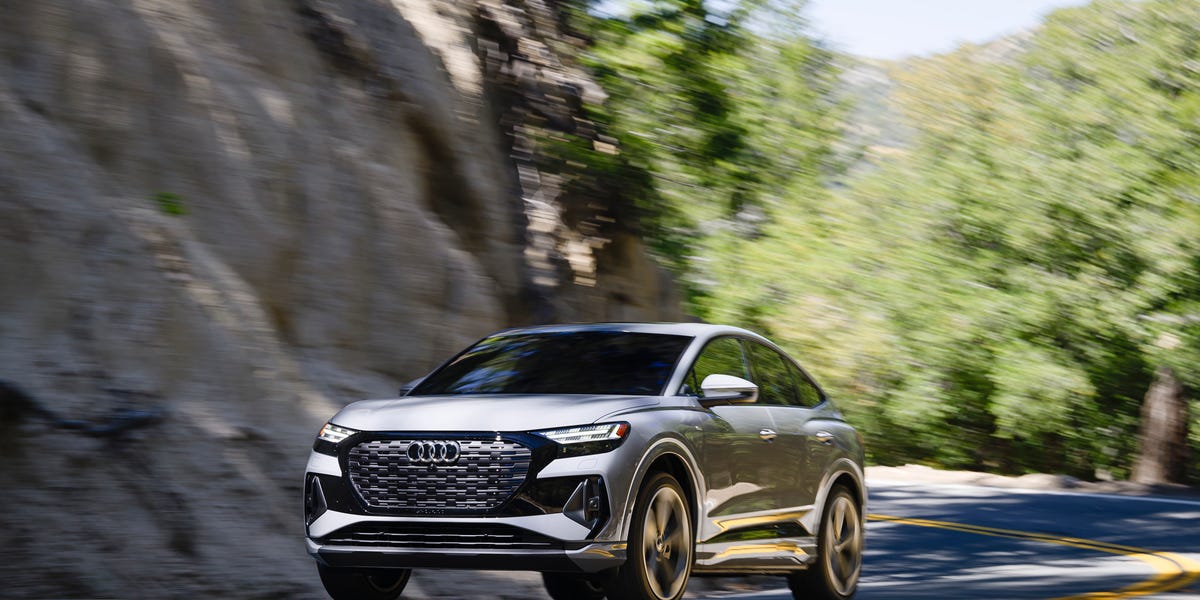
Then comes the first electric car on the list: the Audi Q4 e-tron Sportback, third overall, averaging just 29.8 days on the market. That is quicker than almost everything else out there, petrol included. The fact that an electric SUV can outsell a V8 saloon in the turnover stakes tells you how much the buyer base has broadened.
The EV podium
The three fastest-selling electric models were the Audi Q4 e-tron Sportback, the Toyota bZ4X and the Lexus RZ 300e. It is an interesting trio. The Audi brings premium badge appeal and a sensible family-friendly package. The bZ4X benefits from Toyota’s reputation for reliability. The Lexus RZ 300e offers the same kind of build quality and dealer experience that has long made the brand a favourite with buyers who value a quiet life over a spec sheet.
What they share is a lack of controversy. None of them is a niche product or a compliance special. They are mainstream electric cars that do mainstream jobs, and the used market is rewarding them for it.
Tesla’s price surge
Tesla features heavily in the US price story. The Model S averaged $10,636 more than in September 2025, the Model X $9,336 more, and the Model 3 around $3,870 more. Those are hefty moves for used metal, and they reflect a brand that continues to command attention even as newer rivals arrive. With production of the long-promised next-generation Roadster now slated for 2028 according to earlier AutoPulse reporting, the used Model S and Model X remain the practical way into Tesla ownership for most buyers, and the market has priced that in.
More broadly, EV prices began rising in April 2026, climbed steadily through the spring and summer, and peaked in August. That trajectory suggests a market correcting after a period of over-correction, rather than a short-term spike.
Why buyers are switching
The report links growing EV interest to soaring petrol prices in the United States. When filling a tank becomes a painful weekly ritual, the running cost case for electric motoring gets louder, even for buyers who had previously dismissed it. Add a maturing used market with more choice than ever, from compact crossovers to premium saloons, and the barriers start to fall away.
There is a secondary effect too. Among shoppers who are not specifically looking for an EV, the report notes that luxury brands sell better than mainstream models. Buyers with a fixed budget are discovering that a used premium EV offers more car for the money than a new mainstream one.
What it means for buyers: the bargains may not last
The used EV market is heating up, and the window for genuinely cheap electric motoring is narrowing. Prices are up nearly a tenth in a year, stock is moving in under six weeks, and the models that linger are becoming the exception rather than the rule. If you have been waiting for used EV values to bottom out before buying, the data suggests that moment has passed.
That does not mean every electric car is now expensive, or that you should rush into a purchase you have not researched. Battery health, warranty cover and charging access still matter more than badge or bodystyle, and a used EV bought badly can still be a costly mistake. But the direction of the market is now clear. The stigma that once kept electric cars at the back of the lot has faded, buyers are paying a premium for them, and the days of picking up a nearly new EV at a steep discount look increasingly like a thing of the past.
For more on this, see used superminis.
For more on this, see used prices climbing fast.